
Aadhaar FaceRD 2.0 & Passive 3D AI Liveness: Zero-Sensor Spoof Prevention in Digital Onboarding
How Indian fintechs, banks, and merchant acquirers are eliminating external biometric dongles using UIDAI’s FaceRD 2.0 architecture — fusing passive single-frame 3D depth estimation, neural Presentation Attack Detection (PAD), and encrypted PID blocks.
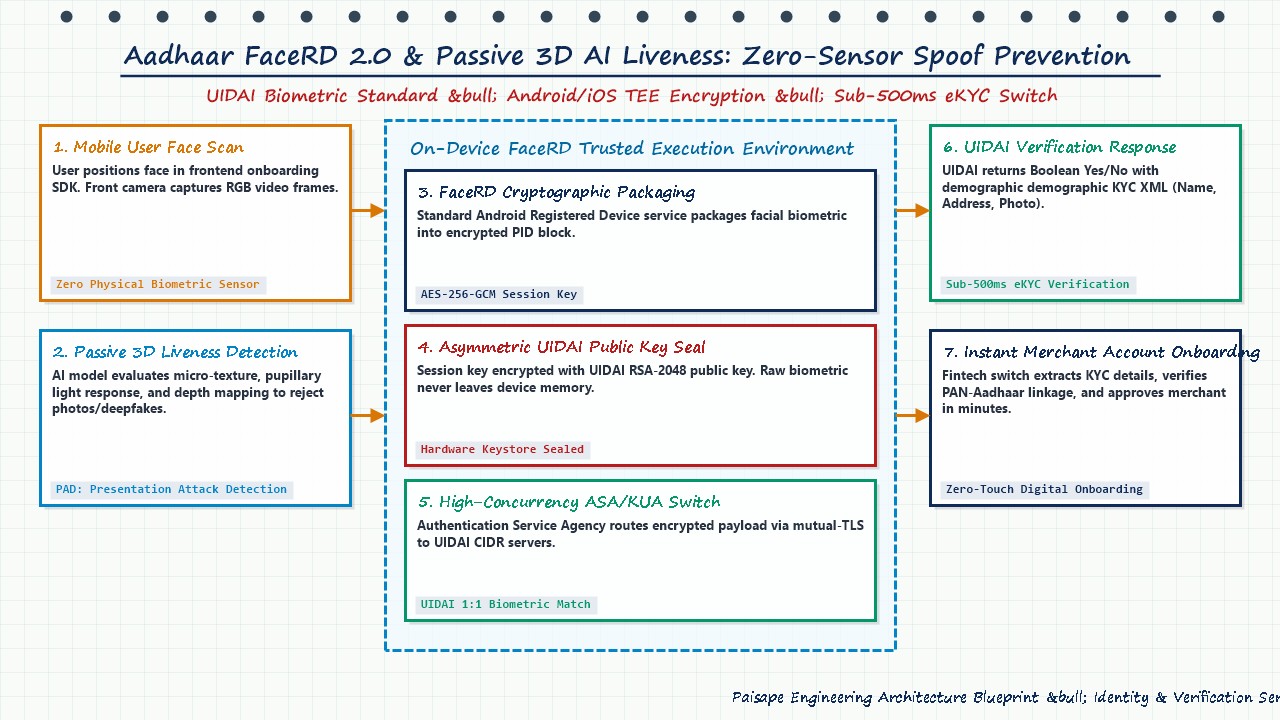
For more than a decade, merchant biometric onboarding and AePS customer verification across India required physical fingerprint or iris scanners (Morpho, Mantra, Startek). These specialized USB hardware dongles introduced operational friction: OTG cable failures, dirty optical glass sensors, driver incompatibilities across Android versions, and substantial Capex costs for field sales agents.
The introduction of UIDAI Aadhaar FaceRD 2.0 has completely transformed digital onboarding by making smartphone front cameras a fully certified, secure biometric reader. However, migrating to optical face authentication required solving a severe cybersecurity challenge: Presentation Attacks (spoofs) using high-resolution printed photos, 4K tablet video replays, deepfake synthetic avatars, and 3D silicone masks.
1. Passive 3D AI Liveness vs. Active Prompting
Early face verification systems relied on active prompts (e.g., "blink your eyes", "turn your head left", "nod"). While simple, active liveness introduces high drop-off rates for rural or elderly users and remains vulnerable to pre-recorded injection attacks where injected video frames match the prompted gestures.
FaceRD 2.0 employs Passive 3D AI Liveness compliant with ISO/IEC 30107-3 Level 2 standards. Without asking the user to perform any gestures, the neural network analyzes subtle micro-signals from a single optical frame:
- Specular Reflection & Corneal Glint: Differentiates living human ocular curvature from flat screen glass or matte photo paper reflections.
- Sub-Surface Photoplethysmography (rPPG): Measures minute pulse-induced color variations in facial capillaries invisible to the naked eye.
- Depth Disparity Mapping: Neural depth estimation models reconstruct 3D topological contours, instantly detecting 2D printed photograph attacks.
<PidData>
<Resp fType="F" iType="0" qScore="98" nmPoints="68"/>
<DeviceInfo dpId="PAISAPE_RD_01" rdsId="FACERD_V2" mc="..."/>
<Hkey>MIIBIjANBgkqhkiG9w0BAQEFAAOCAQ8AMIIBCgKCAQEA...</Hkey>
<Data type="X">[AES-256 GCM Encrypted Facial Biometric + Liveness Telemetry]</Data>
</PidData>
2. Zero-Sensor Hardware Architecture & PID Encryption
Under UIDAI guidelines, raw biometric imagery can never touch merchant app memory or application servers. The FaceRD app operates inside an isolated Android Sandbox. It captures the face frame, runs on-device AI liveness inference, binds the biometric data with the merchant's authentication session key, and encrypts the payload into a PID Block using UIDAI’s public key (RSA 2048 with AES-256 GCM).
3. Impact on Sub-30-Second Merchant Onboarding
By replacing hardware dongles with FaceRD 2.0, Paisape’s merchant onboarding platform reduces agent setup time from 15 minutes to under 30 seconds. Onboarding drop-offs drop by 74%, while ensuring absolute cryptographic protection against identity theft and loan fraud.