
AePS 2.0 Security Mandates: Biometric L1 Upgrades & 2FA Agent Authentication
An engineering breakdown of NPCI & RBI's updated AePS directives — mandatory L1 biometric device migration, agent 2-Factor Authentication, and real-time fr...
Paisape Engineering
Engineering · 12 August 2026
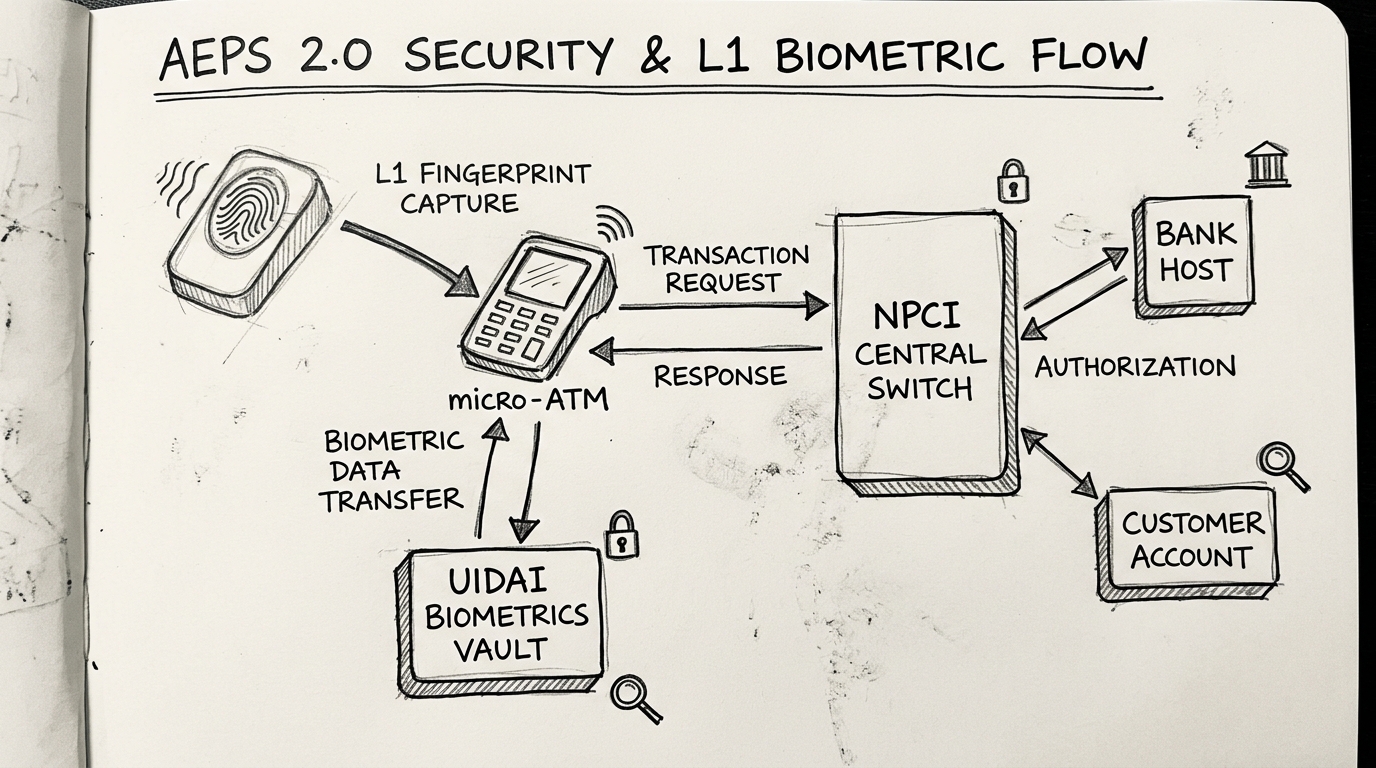
The Regulatory Shift in Aadhaar-Based Banking
The Aadhaar Enabled Payment System (AePS) has brought formal financial services to over 300 million rural and semi-urban citizens across India. However, with daily processing volumes crossing tens of millions of transactions, financial fraudsters have attempted sophisticated exploits—including silicone fake fingerprints, unauthorized Business Correspondent (BC) agent credential sharing, and spoofed device telemetry.
To eliminate these vectors permanently, the National Payments Corporation of India (NPCI) alongside the Reserve Bank of India (RBI) mandated a nationwide overhaul of the AePS ecosystem. Known colloquially as AePS 2.0, these directives enforce strict hardware and software upgrades across all Acquirer Banks, TSP platforms, and Micro-ATM manufacturers.
1. Transition from L0 to L1 Registered Devices (RD)
The core of the new mandate centers on the retirement of legacy L0 biometric sensors in favor of mandatory L1 Registered Devices.
- L0 Devices (Legacy): Biometric template extraction was performed in software on the host OS (Android/Windows). The raw minutiae payload was encrypted before transmission, but malicious apps on rooted devices could theoretically intercept memory during extraction.
- L1 Devices (Mandatory Standard): Template extraction, liveness detection, and key signing occur completely inside a hardware-isolated Trusted Execution Environment (TEE) / Secure Element within the scanner hardware itself. Raw biometric data never touches the host processor or RAM.
For FinTech platforms, integrating L1 RD services requires updating native SDK drivers and implementing real-time device certificate validation on the backend server before building the ISO 8583 payload for NPCI switch submission.
2. Mandatory Agent Two-Factor Authentication (2FA)
Historically, a BC agent would log into their Micro-ATM app once at the beginning of the day. Fraudsters exploited this by leaving terminal sessions unattended or delegating devices to unauthorized third parties.
Under the updated AePS guidelines:
- Daily First-Logon 2FA: Every agent must authenticate using their own Aadhaar biometric scanning before processing any customer cash withdrawal or balance inquiry for the day.
- Transaction-Level Risk-Based 2FA: If an agent processes high-value cash withdrawals or handles consecutive transactions across multiple bank accounts in short intervals, the switch enforces an intermediate agent biometric verification trigger.
3. Real-Time Fraud & Anomaly Detection (FDS)
Acquirer Bank switches must now communicate with NPCI’s Centralized Risk & Fraud Monitoring engine via synchronous risk API checks. Key flags being monitored in real-time include:
- Velocity Checks: Unusually high frequency of cash withdrawals originating from a single Micro-ATM terminal within a 5-minute window.
- Geo-Spatial Mismatches: A Micro-ATM terminal registered in Maharashtra suddenly attempting transactions originating from IP addresses or tower IDs in another state.
- Biometric Retry Spikes: High ratio of consecutive biometric mismatch failures on a single BC device, indicating potential forced trial attacks.
Impact on FinTech & TSP Integrations
For payment service providers, adapting to these AePS security changes is non-negotiable. Systems must update payload serializers, gracefully handle new NPCI error decline codes (such as A102 - L0 Device Deprecated or A201 - Agent 2FA Timeout), and ensure seamless fallback logic.
By implementing these continuous security enhancements, AePS remains the safest, most resilient last-mile payment infrastructure in the global digital economy