
Audit Trails Your Regulator Will Actually Accept
What to log at each hop, how long to keep it, and the gaps that turn a routine inspection into a long quarter.
Paisape Engineering
Engineering · 12 August 2026
Logging is Not Auditing: The Regulator's Perspective
In the fast-paced world of software engineering, it is easy to conflate logging with auditing. We routinely dump application state, debugging information, and JSON payloads into ELK stacks or S3 buckets and call it a day. However, when the Reserve Bank of India (RBI) conducts an inspection, they are not looking for your application logs. They are looking for a true, immutable, and non-repudiable audit trail.
An audit trail is fundamentally different from a system log. A log answers the question "What happened in the system?" An audit trail answers the question "Who did what to which record, when, from where, and with whose authorization?" If an RBI auditor asks, 'Who authorized the reversal of transaction TXN-9982 on Tuesday at 4:00 AM?', responding with a grepped log file containing a mix of application errors and database queries is a surefire way to turn a routine inspection into a prolonged, painful, and potentially penalizing ordeal.
The Anatomy of a Compliant Audit Record
To design an audit trail that satisfies regulatory scrutiny, every critical financial and administrative action must generate an isolated, structured audit record. The core elements of a compliant audit record are non-negotiable. Missing even one of these elements can render the entire trail suspect in the eyes of an auditor.
- Precise Temporal Anchor: The exact timestamp of the action, always recorded in UTC to avoid timezone ambiguities across distributed systems.
- Identity of the Actor: Who performed the action? This must resolve to a specific human user (via User ID) or a specific authenticated system process/service account. Generic admin accounts are a massive red flag.
- The Action Taken: A clear, standardized string denoting the operation (e.g.,
INITIATE_REFUND,UPDATE_MERCHANT_MDR,APPROVE_SETTLEMENT). - State Transformation (Before/After): Perhaps the most critical element. The audit record must capture the exact state of the entity before the change and the exact state after. This proves what was actually modified.
- Originating Context: The IP address, device footprint, and session ID from which the action was initiated.
- Cryptographic Signature: A hash of the payload, signed by the audit service, to prove the record has not been tampered with since creation.
Designing for Immutability and Non-Repudiation
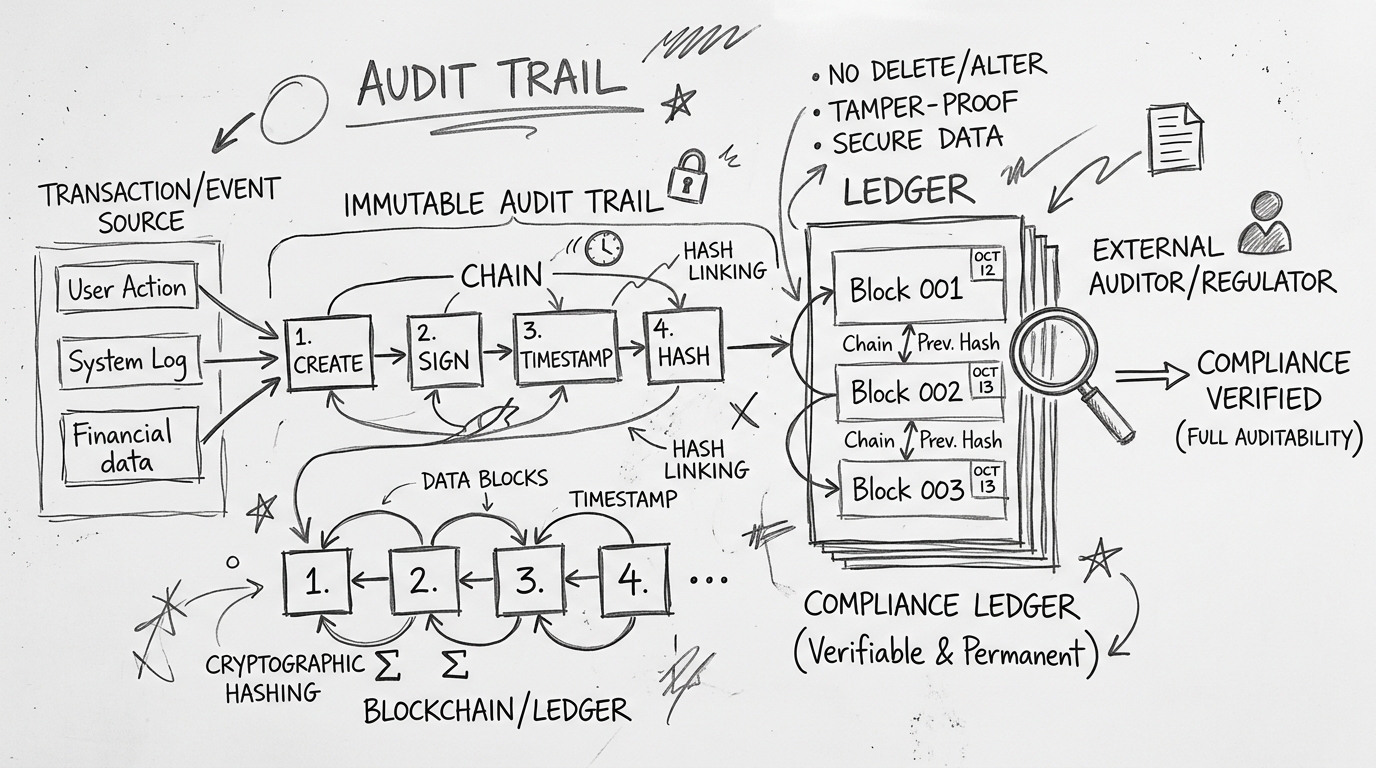
The defining characteristic of an audit trail is immutability. Once an event is recorded, it must be mathematically and practically impossible to alter or delete it without detection. Standard relational databases, while excellent for transactional integrity, are inherently mutable. An administrator with UPDATE or DELETE privileges can alter history.
To achieve true immutability, engineering teams must adopt append-only architectures. There are several ways to implement this, ranging from Write-Once-Read-Many (WORM) storage appliances to blockchain-inspired cryptographic chaining.
A highly effective and relatively straightforward approach is to implement a cryptographic hash chain. When Audit Record $N$ is created, its hash includes the hash of Audit Record $N-1$. This creates an unbroken chain of cryptographic evidence. If a malicious actor (or a careless DBA) attempts to modify Record 5, the hash of Record 5 changes. Because Record 6 includes the original hash of Record 5, the chain breaks, immediately flagging the tampering. When an auditor asks for proof of integrity, you simply recalculate the hashes from the genesis block to the current head; if they match, the ledger is pristine.
The 7-Year Itch: Strategies for Long-Term Data Retention
Under various RBI guidelines and the Prevention of Money Laundering Act (PMLA), financial institutions, Payment Aggregators (PAs), and Payment Gateways (PGs) in India are generally required to retain transaction and audit data for a minimum of 7 to 10 years.
Retaining billions of audit records for a decade presents a massive infrastructural and financial challenge. Keeping 7 years of high-volume transaction data in a hot, provisioned relational database like PostgreSQL or Oracle is prohibitively expensive and degrades query performance for current operations. The solution lies in a robust, automated tiered storage strategy.
Tier 1: Hot Storage (0-6 Months). Recent audit data needs to be readily accessible for customer support, immediate dispute resolution, and internal operational reporting. This data lives in highly optimized, indexed databases (like Elasticsearch or a dedicated Postgres cluster). Query latency here is measured in milliseconds.
Tier 2: Warm Storage (6 Months - 2 Years). As data ages, the probability of it being queried drops exponentially. Data in this tier can be moved to cheaper storage solutions, such as Amazon S3 or Google Cloud Storage, partitioned by date (e.g., year=2024/month=10/day=05/) and stored in an optimized columnar format like Apache Parquet. Querying is handled via analytical engines like Amazon Athena or Presto, where queries might take seconds instead of milliseconds, which is acceptable for older investigations.
Tier 3: Cold/Archive Storage (2 Years - 10 Years). This is strictly for regulatory compliance. The data is rarely, if ever, accessed unless explicitly requested by an authority. For this tier, data is compressed and moved to deep archive storage classes like Amazon S3 Glacier Deep Archive. Storage costs are pennies on the dollar, but retrieval can take 12 to 48 hours. Crucially, the cryptographic signatures and hash chains must be preserved perfectly through every transition to prove the data remains untampered across the decade.
Handling Schema Evolution over a Decade
One of the most insidious challenges of 7-year retention is schema evolution. Your application's data model today looks nothing like it did 5 years ago, and it won't look the same 5 years from now. If you store a JSON blob of the 'Before/After' state today, how will your reporting tools understand it in 2030?
Audit records must be somewhat schema-agnostic or strictly versioned. It is highly recommended to store the schema version alongside the payload in the audit record (e.g., schema_version: "v2.4"). When retrieving a 5-year-old record, the presentation layer must use the corresponding schema definition to correctly interpret and display the fields to the auditor. Attempting to force old audit records into a new schema will inevitably result in data loss or misinterpretation, both of which are unacceptable in a regulatory context.
Conclusion: Compliance as a First-Class Engineering Discipline
Designing an audit trail is not an afterthought to be tacked on before a product launch; it is a fundamental architectural pillar for any FinTech operating in a regulated environment. By treating compliance as a first-class engineering discipline—utilizing cryptographic chaining for immutability, implementing smart tiered storage for cost-effective retention, and strictly managing schema evolution—we ensure that when the regulator comes knocking, we can provide precise, irrefutable answers without breaking a sweat.