Credit Line on UPI: API Architecture & Integration Guide for Indian Fintechs
A complete technical and compliance guide to NPCI Credit Line on UPI — pre-approved credit linking, Loan Account Systems (LAA), real-time authorization, MDR rules, and bank switch integration.
1. Executive Summary: The Revolution of UPI Credit
In September 2023, the Reserve Bank of India (RBI) and National Payments Corporation of India (NPCI) launched Credit Line on UPI — transforming India's payment landscape by enabling pre-sanctioned credit lines from scheduled commercial banks to be linked directly to a customer's UPI VPA. Previously, UPI allowed transactions funded only by savings accounts, overdraft accounts, prepaid wallets, and RuPay Credit Cards. Credit Line on UPI opens a multi-billion dollar opportunity for banks, NBFCs, and fintech payment aggregators to disburse credit seamlessly at millions of QR codes across India.
2. Core Architectural Pillars of CLOU
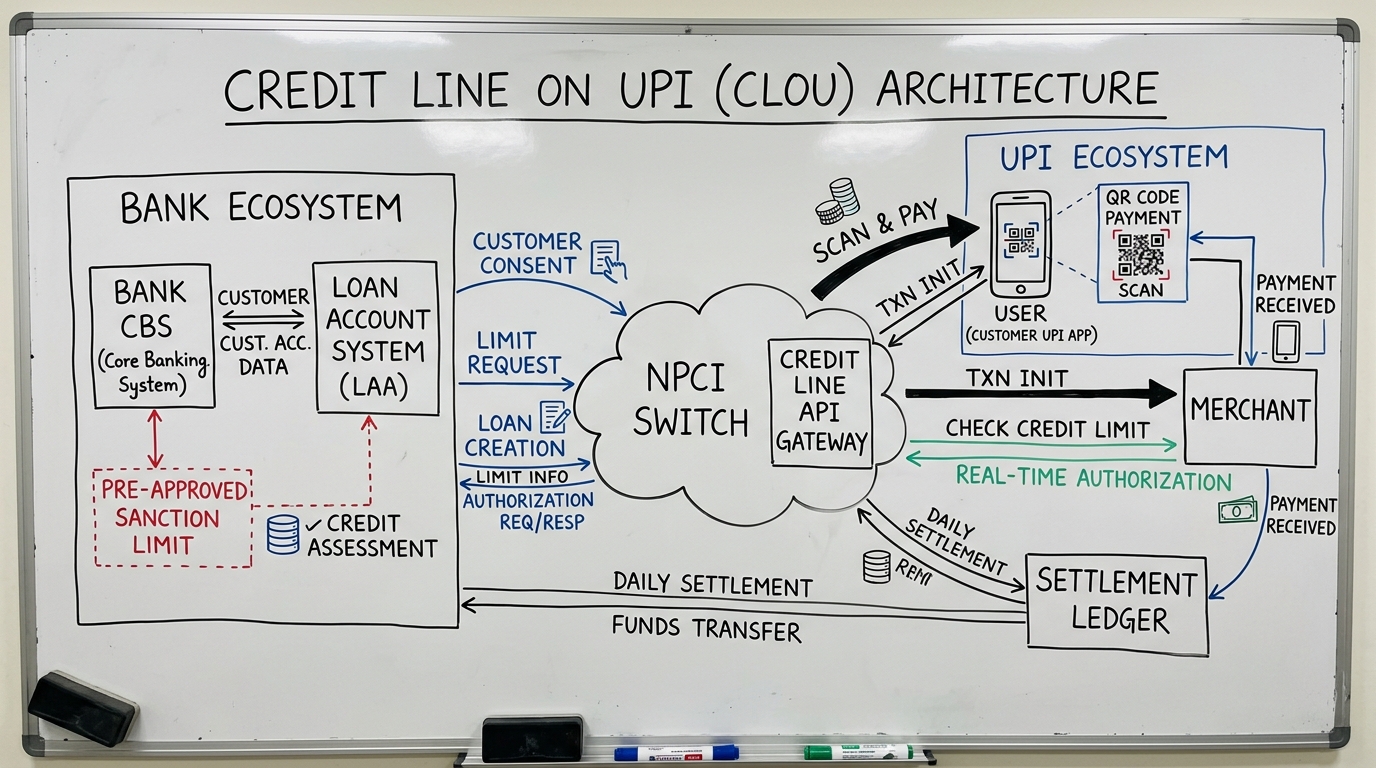
The Credit Line on UPI (CLOU) stack requires low-latency synchronization across four major infrastructure components:
- Loan Account System (LAA): The bank's core credit engine managing pre-approved limits, active drawdowns, repayment cycles, and interest calculations.
- Bank UPI Switch: The high-throughput switch (e.g. FSS, NPCI Switch, Wibmo) processing ISO 8583 / XML payload messages between NPCI and the bank's LAA engine.
- TPAP / UPI App Layer: Customer-facing UPI applications (BHIM, Google Pay, PhonePe, Paytm) allowing customers to discover, consent to, link, and transact using their pre-sanctioned credit lines.
- Acquiring PG / PA Switch: Merchant-facing switches handling merchant category codes (MCCs), fee calculations (MDR), and real-time authorization responses.
3. Technical Flow: Account Discovery, Linking & Real-Time Debit
Credit Line on UPI relies on three mandatory API workflows:
- Credit Line Discovery: User initiates bank discovery via mobile number. Bank returns pre-approved credit accounts with masked account numbers and available credit limits.
- VPA Binding & MPIN Setup: User binds their credit line to their UPI VPA and sets a 4/6-digit UPI MPIN via debit card / Aadhaar OTP authentication.
- Transaction Authorization: When user scans a merchant QR code, the acquiring switch passes the transaction payload to NPCI, which routes it to the issuing bank's LAA engine. The engine verifies credit balance, locks funds, and responds with approval in under 300 milliseconds.
1. UPI क्रेडिट लाइन क्या है?
सितंबर 2023 में भारतीय रिजर्व बैंक (RBI) और NPCI ने Credit Line on UPI की शुरुआत की — जिससे ग्राहक अपने बैंक के पूर्व-स्वीकृत क्रेडिट लिमिट को सीधे UPI ID से जोड़ सकते हैं।
2. क्रेडिट लाइन की मुख्य विशेषताएं
इसके जरिए ग्राहक बिना क्रेडिट कार्ड के किसी भी मर्चेंट QR कोड पर स्कैन करके भुगतान कर सकते हैं।