
Pre-Sanctioned Credit Lines on UPI: Core Banking Shadow Ledgers & Instant Reversal Switches
How Indian banks and fintech switches engineer sub-10ms transaction authorizations on pre-sanctioned credit lines using distributed shadow ledgers, avoiding core banking deadlocks while providing real-time interest calculation.
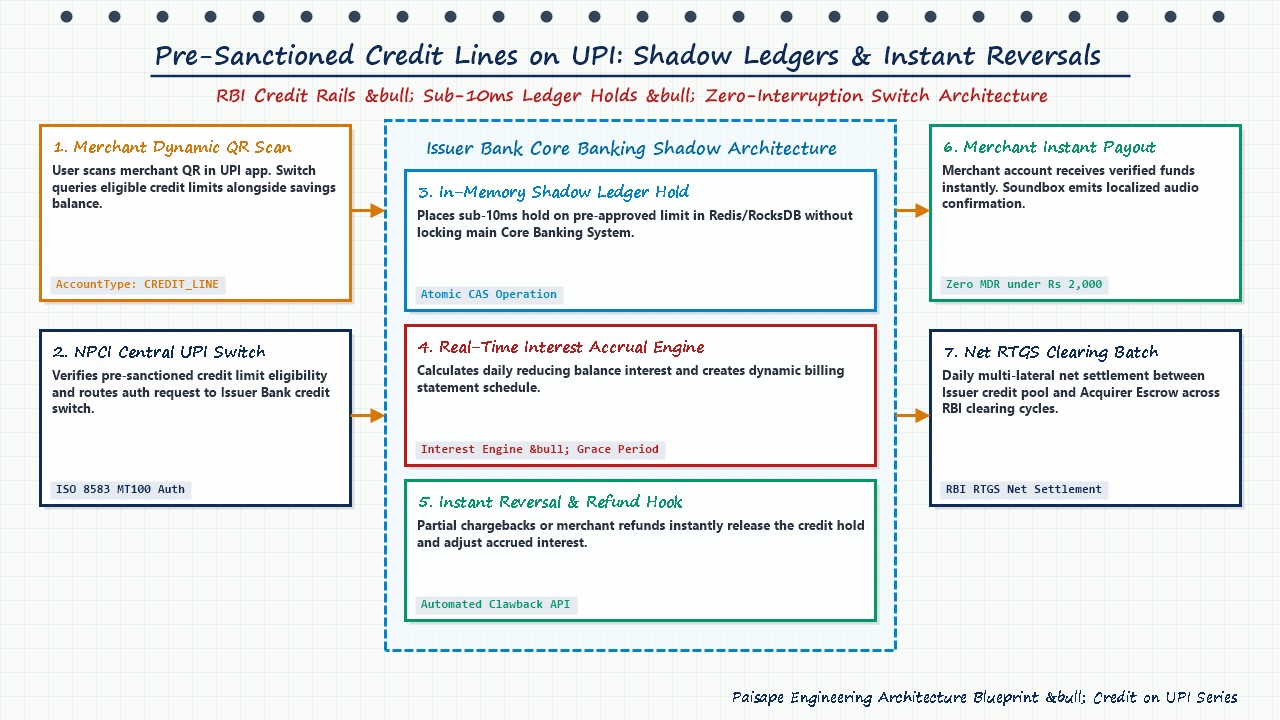
The Reserve Bank of India’s authorization allowing pre-sanctioned credit lines as funding accounts on UPI marked a revolutionary paradigm shift. Instead of maintaining credit cards with distinct magnetic stripes and EMV chips, consumers can link pre-approved bank credit lines directly to their existing Virtual Payment Addresses (VPAs).
However, from a switch engineering perspective, running high-concurrency revolving credit transactions over UPI rails presents profound scalability bottlenecks for traditional legacy Core Banking Systems (CBS). Standard savings account debits execute simple atomic balance deductions. In contrast, credit line authorizations require credit limit verification, sub-limit categorization, daily reducing balance interest accrual, grace period eligibility checks, and interchange processing—all within UPI’s unforgiving sub-200ms round-trip SLA.
1. The Core Banking Bottleneck & Distributed Shadow Ledgers
Legacy CBS relational databases lock customer loan account rows during ACID transactions. When thousands of users swipe or scan UPI QR codes simultaneously during peak evening hours, row locks create systemic switch timeouts, causing cascaded U30 (Transaction Timed Out) failures across the NPCI ecosystem.
To eliminate this bottleneck, modern issuer banks deploy an In-Memory Shadow Ledger layer (built on distributed Redis clusters or embedded RocksDB engines) positioned directly between the UPI switch and the core banking ledger:
const holdResult = await shadowLedger.eval(
`local avail = tonumber(redis.call('HGET', KEYS[1], 'avail_limit'))
local amt = tonumber(ARGV[1])
if avail >= amt then
redis.call('HINCRBYFLOAT', KEYS[1], 'avail_limit', -amt)
redis.call('HSET', KEYS[2], ARGV[2], ARGV[3]) -- Store Hold Record
return 1
else return 0 end`,
2, `credit_line:${vpa}`, `holds:${txnId}`, amount, txnDetails
);
2. Real-Time Interest Accrual & Dual Billing Cycles
Unlike personal loans disbursed as lump sums, UPI credit lines charge interest strictly on the exact utilized quantum on a daily reducing balance. When an authorization hold confirms into a finalized debit, the switch assigns an ISO 20022 clearing timestamp.
If the user repays the drawn amount within the interest-free grace window (typically 15 to 45 days, depending on product construct), the interest engine zeroes the accrual register. For delayed or revolving balances, compound interest accrues atomically at midnight EOD via Kafka-streamed ledger batches without ever locking transaction tables.
3. Instant Reversals & Partial Refund Hooks
Merchant cancellations, delivery rejections, or dynamic QR timeout auto-reversals must be processed in real-time. In credit line mechanics, restoring a balance requires not only increasing available credit limit but also unwinding accrued interest recalculations.
Paisape’s smart switch routing provides automated webhooks that execute compensating credit-line reversals within 50 milliseconds of receiving NPCI’s ReqRev directive, guaranteeing zero consumer grievance escalations.