
Celebrating Financial Independence: India's Digital Payment Revolution
Reflecting on India's incredible journey towards true financial independence through Digital Public Infrastructure.
Paisape Engineering
Engineering · 15 August 2026
The Backbone of Financial Inclusion in India
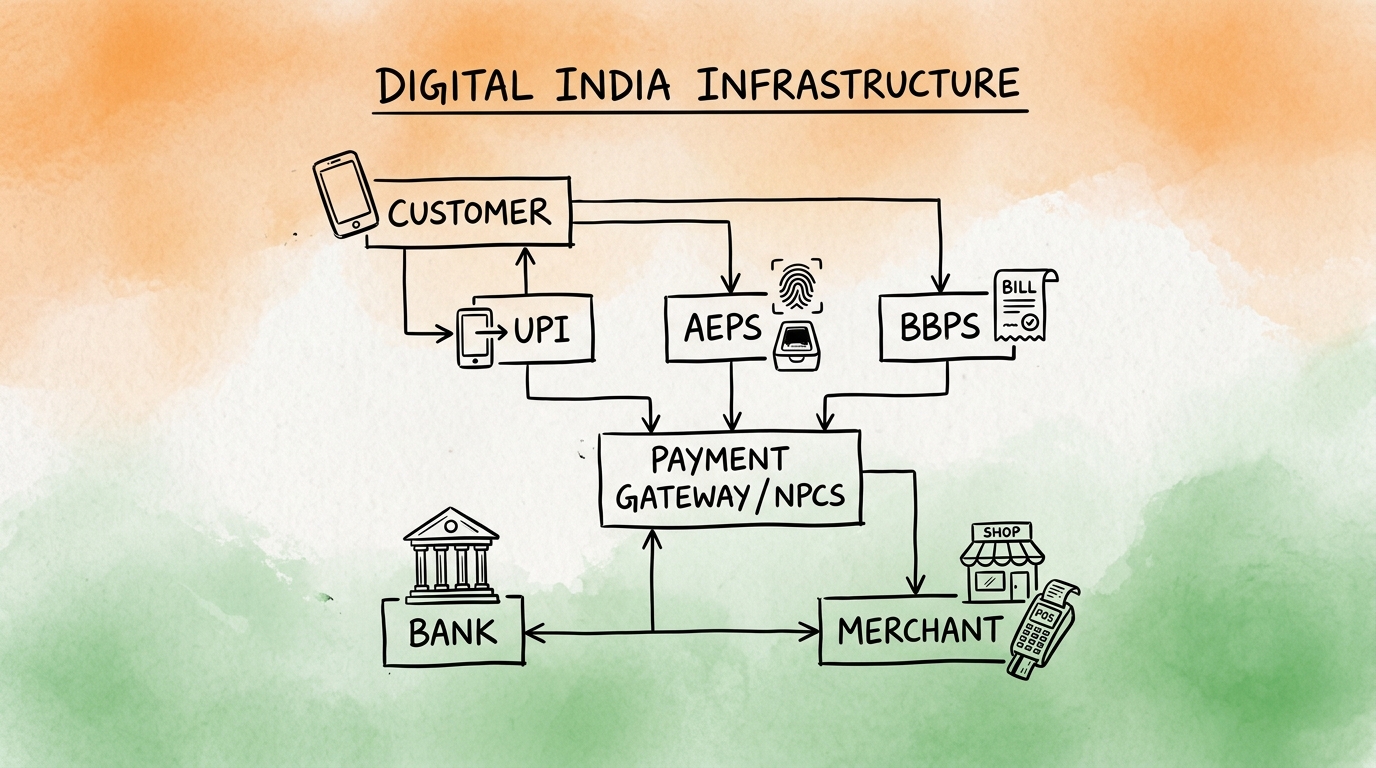
The Aadhaar Enabled Payment System (AEPS) is arguably one of the most transformative financial technologies deployed globally. Conceived by the National Payments Corporation of India (NPCI) in collaboration with the Unique Identification Authority of India (UIDAI), AEPS enables online, interoperable financial inclusion transactions at Micro-ATMs or Point of Sale (PoS) devices. It empowers the unbanked and underbanked population to perform basic banking functions—cash withdrawals, balance inquiries, mini statements, and fund transfers—using nothing more than their Aadhaar number and biometric authentication.
Operating primarily through a vast network of Business Correspondents (BCs) or "Bank Mitras," AEPS processes millions of transactions daily, serving as the financial lifeline for rural and semi-urban India. Understanding the architecture and mechanics behind this massive, distributed system reveals a complex orchestration of cryptography, real-time routing, and decentralized infrastructure.
The AEPS Architecture: A Multi-Node Ecosystem
The architecture of AEPS is inherently multi-party, requiring seamless synchronization between several disparate entities in a matter of seconds. When a transaction is initiated, it traverses a complex path before completion. The primary actors in this ecosystem are:
- The Customer: The account holder whose bank account is seeded with their Aadhaar number.
- The Business Correspondent (BC): The agent operating the biometric device (Micro-ATM) and the BC application.
- The Acquirer Bank: The bank that has sponsored the BC and provides the frontend application and connectivity to the NPCI network.
- NPCI (National Payments Corporation of India): The central clearing and routing hub that manages the National Financial Switch (NFS) and the AEPS switch.
- UIDAI (Unique Identification Authority of India): The central repository of Aadhaar data, responsible for verifying the biometric input.
- The Issuer Bank: The bank where the customer holds their account and maintains the ledger.
The Biometric Authentication Flow: From Sensor to Server
The transaction lifecycle begins the moment a customer places their finger on a biometric scanner. The security of this initial step is paramount, as biometric data is highly sensitive and immutable.
To prevent data leakage or replay attacks, UIDAI mandates the use of Registered Devices (RD). A Registered Device ensures that the biometric capture and its subsequent encryption occur entirely within the trusted execution environment of the hardware sensor itself, rather than in the host operating system of the mobile phone or PC.
When the fingerprint is captured, the RD service encrypts the raw biometric data using a 256-bit AES session key. This encrypted payload, along with device metadata (like device ID and timestamp), forms the Personal Identity Data (PID) block. The AES session key is then asymmetrically encrypted using UIDAI’s public key. The BC application bundles this encrypted PID block with the customer's Aadhaar number (or Virtual ID), the transaction amount, and the Issuer Bank's IIN (Institution Identification Number) to form the AEPS request payload.
This payload is securely transmitted over HTTPS to the Acquirer Bank's switch. The Acquirer Bank logs the transaction for settlement purposes but cannot decrypt the biometric data, as it lacks UIDAI's private key. The Acquirer then forwards the payload to the NPCI AEPS switch.
National Financial Switch (NFS) Routing and Verification
NPCI acts as the grand orchestrator of the AEPS transaction. When the AEPS switch receives the payload from the Acquirer Bank, it performs a dual-routing process that must be executed with incredibly low latency.
First, NPCI routes the authentication component to the UIDAI's Authentication Service Agency (ASA). NPCI acts as the intermediary, forwarding the encrypted PID block and Aadhaar number. UIDAI's servers use their private key to decrypt the session key, then decrypt the PID block, and finally perform a 1:1 match of the provided fingerprint against the biometric data stored in the Central Identities Data Repository (CIDR) for that specific Aadhaar number.
UIDAI responds to NPCI with a simple Boolean response: 'YES' (Authentication Successful) or 'NO' (Authentication Failed), accompanied by an error code if failed.
If UIDAI returns a 'YES', the NPCI switch instantly routes the financial leg of the transaction over the National Financial Switch (NFS) to the Issuer Bank, utilizing the IIN provided in the initial request. The NFS translates the AEPS message into standard ISO 8583 financial messaging formats understood by core banking systems.
The Issuer Bank receives the request, verifies that the account is active, checks for sufficient balance, and processes the debit (in the case of a cash withdrawal). The Issuer Bank then sends a success or failure response back through the NFS to NPCI. Finally, NPCI aggregates the UIDAI authentication result and the Issuer Bank's financial result, and routes the final transaction status back to the Acquirer Bank, which in turn notifies the BC application to dispense the cash.
This entire multi-hop journey—from rural village to Acquirer, to NPCI, to UIDAI, back to NPCI, to the Issuer Bank, and back to the village—must happen within a strict timeout window, typically 15 to 30 seconds.
Edge Cases, Routing Failures, and Systemic Challenges
Operating at this scale exposes the system to numerous edge cases and failure modes. Biometric mismatches are a primary cause of failure, often resulting from manual labor (which degrades fingerprints), dirty sensors, or improper finger placement. To mitigate this, robust BC applications guide users through multiple attempts or suggest alternative fingers.
Connectivity is another massive hurdle. BCs often operate in areas with fluctuating 3G/4G networks. If a network drop occurs after the Issuer Bank has debited the account but before the success message reaches the BC application, it results in a 'Deemed Success' or a 'Pending' state. The customer's account is debited, but the BC does not dispense cash. Resolving these discrepancies requires complex, automated reconciliation and settlement processes between the Acquirer, NPCI, and the Issuer, driven by strict RBI Turn Around Time (TAT) guidelines for auto-reversals.
Furthermore, Issuer Bank downtimes are a reality. Core Banking Systems (CBS) undergo maintenance or buckle under the load of Direct Benefit Transfer (DBT) credit days (like PM-KISAN payouts). During these periods, NPCI's switch must intelligently manage the queue, sometimes applying throttling or returning immediate 'Issuer Unavailable' codes to prevent widespread transaction timeouts and locked funds.
The Future of Biometric Payments
As AEPS continues to evolve, the architecture is adapting. The introduction of Face Authentication as an alternative or supplement to fingerprint scanning is reducing the failure rates associated with faded fingerprints. Furthermore, advancements in edge computing and offline transaction capabilities (like RBI's offline retail payments framework) are being explored to make the system resilient even in zero-connectivity zones.
AEPS is a masterclass in distributed systems architecture, securely bridging the physical and digital worlds to deliver financial services to the last mile. For engineering teams building in this space, optimizing the BC application for low bandwidth, handling asynchronous reconciliation flawlessly, and maintaining strict compliance with UIDAI's ever-evolving security mandates are the keys to success.