
Merchant Acquiring & Dynamic QR Code Engine: High-Throughput NPCI Payload Generation
An engineering guide to dynamic UPI QR code generation — EMVCo specifications, Base64 payload encoding, transaction reference binding, instant webhook callback hooks, and acquirer switch integration.
1. Static vs. Dynamic QR Codes in Merchant Acquiring
In retail and billing environments, Static QR stickers printed at checkout counters require customers to manually enter the exact transaction amount. This introduces human input errors, wrong payment amounts, and manual merchant verification delays.
A Dynamic UPI QR Code Engine automatically embeds the exact payable amount, unique merchant VPA, order reference ID, and transaction note directly into a single, dynamically generated EMVCo-compliant QR image. When the customer scans the QR code on any UPI app, the exact amount is pre-filled and locked, allowing 1-tap instant payment with < 50ms payload generation latency.
2. Core Architectural Components of a Dynamic QR Engine
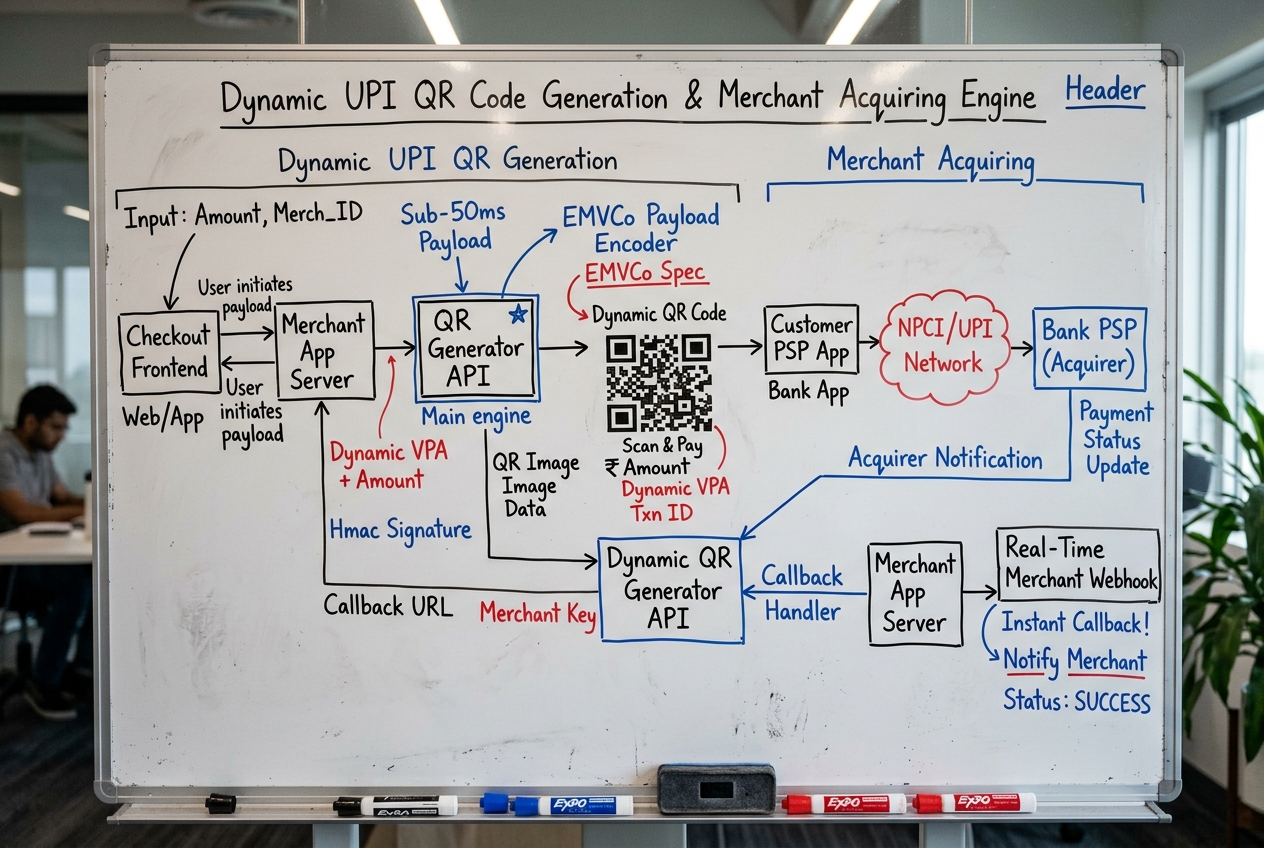
As illustrated in the hand-drawn technical architectural whiteboard blueprint above, a production-grade merchant acquiring QR engine consists of five integrated modules:
- Merchant App / Billing POS Server: Initiates the payment request containing order ID, merchant key, and exact payable amount (e.g. ₹1,499.00).
- QR Generator API (Payload Engine): High-throughput microservice generating cryptographically signed NPCI UPI deep links and EMVCo payloads.
- EMVCo Specification Encoder: Converts UPI parameters (VPA, amount, tr, tn, mc) into standardized Tag-Length-Value (TLV) payload strings with CRC16 error checking.
- Customer PSP & NPCI UPI Network: Routes the scanned transaction to the issuing bank for instant PIN authorization.
- Real-Time Webhook Callback Handler: Receives acquirer payment confirmation and dispatches instant HTTP webhooks to the merchant's POS billing system.
3. Anatomy of an NPCI-Compliant Dynamic UPI Payload
upi://pay?pa=paisape@upi&pn=MerchantName&mc=5411&tr=TXN9842103&am=1499.00&cu=INR&tn=Order9842
pa(Payee Address): Merchant's verified VPA (e.g.paisape@upi).pn(Payee Name): Registered legal business or brand name.mc(Merchant Category Code): 4-digit NPCI/Visa MCC code (e.g.5411for Grocery Stores).tr(Transaction Ref ID): Unique order reference number generated by the merchant POS.am(Amount): Fixed payable transaction amount pre-filled and locked.tn(Transaction Note): Order summary or bill reference text displayed on user app.
4. Key Engine Performance Metrics
| Metric | Target SLA | Technical Implementation |
|---|---|---|
| QR Payload Latency | < 50ms | In-memory C++ / Go payload string generation |
| Throughput (RPS) | 10,000+ Requests/sec | Stateless microservices auto-scaled behind Load Balancers |
| Webhook Callback SLA | < 100ms | Asynchronous Redis/RabbitMQ message queue dispatch |
5. Engineering Best Practices
- Short TTL for Dynamic QR Codes: Expire generated dynamic QR codes after 5-10 minutes to prevent accidental duplicate payments on expired orders.
- HMAC Signature Verification: Sign inbound POS payload requests with a secret merchant HMAC key to prevent unauthorized QR generation.
- Webhook Retry Strategy: Implement exponential backoff retries (30s, 2m, 10m) for failed merchant POS webhook notifications.
6. Conclusion
A dynamic UPI QR code engine turns retail and digital checkouts into seamless 1-tap payment experiences. By encoding EMVCo payloads in sub-50ms latency and pushing real-time acquirer webhooks, Indian merchants eliminate billing errors and accelerate checkout speed.
1. मर्चेंट एक्वायरिंग में स्टेटिक बनाम डायनेमिक QR कोड
खुदरा स्टोर और बिलिंग काउंटरों पर प्रिंट किए गए स्टेटिक QR कोड में ग्राहकों को भुगतान राशि मैन्युअल रूप से टाइप करनी पड़ती है। इससे मानवीय गलतियां, गलत रकम ट्रांसफ़र होना और बिलिंग काउंटरों पर देरी होती है।
एक डायनेमिक UPI QR कोड इंजन सटीक देय राशि, अद्वितीय मर्चेंट VPA, ऑर्डर संदर्भ आईडी (TR) और ट्रांजैक्शन नोट को एक ही गतिशील रूप से उत्पन्न EMVCo-अनुपालन QR छवि में एन्कोड करता है। जब ग्राहक किसी भी UPI ऐप से इस QR कोड को स्कैन करता है, तो राशि स्वचालित रूप से भर जाती है और लॉक हो जाती है, जिससे < 50ms पेलोड निर्माण लैटेंसी के साथ 1-टैप त्वरित भुगतान संभव होता है।
2. डायनेमिक QR इंजन के मुख्य आर्किटेक्चरल घटक
जैसा कि ऊपर दिए गए व्हाइटबोर्ड आरेख में दिखाया गया है, एक मर्चेंट एक्वायरिंग QR इंजन में 5 एकीकृत मॉड्यूल होते हैं:
- मर्चेंट ऐप / POS सर्वर: भुगतान अनुरोध शुरू करता है जिसमें ऑर्डर आईडी, मर्चेंट कुंजी और सटीक देय राशि शामिल होती है।
- QR जनरेटर API: उच्च-थ्रूपुट माइक्रोसर्विस जो डिजिटल हस्ताक्षर वाले NPCI UPI दीप-लिंक और EMVCo पेलोड उत्पन्न करती है।
- EMVCo विनिर्देश एन्कोडर: UPI मापदंडों (VPA, राशि, TR, TN, MC) को CRC16 त्रुटि जांच के साथ मानकीकृत टैग-लेंथ-वैल्यू (TLV) स्ट्रिंग में परिवर्तित करता है।
- ग्राहक PSP एवं NPCI UPI नेटवर्क: पिन प्राधिकरण के लिए बैंक को स्कैन किए गए ट्रांजैक्शन की पुष्टि भेजता है।
- रीयल-टाइम वेबहुक कॉलबैक हैंडलर: बैंक से भुगतान पुष्टि प्राप्त करता है और मर्चेंट के POS बिलिंग सिस्टम को तुरंत HTTP वेबहुक भेजता है।
3. NPCI-अनुपालक डायनेमिक UPI पेलोड की संरचना
upi://pay?pa=paisape@upi&pn=MerchantName&mc=5411&tr=TXN9842103&am=1499.00&cu=INR&tn=Order9842
pa(पेयी एड्रेस): मर्चेंट का सत्यापित UPI VPA (उदा.paisape@upi)।pn(पेयी नाम): मर्चेंट का कानूनी व्यापार नाम।mc(मर्चेंट कैटेगरी कोड): 4-अंकीय NPCI मर्चेंट कोड (उदा.5411)।tr(ट्रांजैक्शन रिफरेंस ID): मर्चेंट POS द्वारा उत्पन्न अद्वितीय ऑर्डर संख्या।am(राशि): पहले से भरी गई और लॉक की गई देय राशि।tn(ट्रांजैक्शन नोट): ग्राहक ऐप पर प्रदर्शित ऑर्डर सारांश।
4. इंजन प्रदर्शन मीट्रिक्स (SLA Table)
| मीट्रिक | लक्ष्य SLA | तकनीकी कार्यान्वयन |
|---|---|---|
| QR पेलोड लैटेंसी | < 50ms | In-memory C++ / Go पेलोड स्ट्रिंग जनरेशन |
| थ्रूपुट (RPS) | 10,000+ अनुरोध/सेकंड | लोड बैलेन्सर के पीछे ऑटो-स्केलिंग माइक्रोसर्विसेज |
| वेबहुक कॉलबैक SLA | < 100ms | Redis / RabbitMQ मैसेज क्यू द्वारा एसिंक्रोनस प्रेषण |
5. इंजीनियरिंग सर्वोत्तम प्रथाएं
- डायनेमिक QR कोड के लिए कम TTL: पुराने या समाप्त हो चुके ऑर्डर पर दोबारा गलती से भुगतान रोकने के लिए 5-10 मिनट बाद Dynamic QR निष्पादित करें।
- HMAC हस्ताक्षर सत्यापन: अनधिकृत QR जनरेशन को रोकने के लिए मर्चेंट गुप्त कुंजी से सभी आने वाले अनुरोधों को हस्ताक्षरित करें।
- वेबहुक पुनः प्रयास रणनीति: असफल वेबहुक सूचनाओं के लिए घातीय बैकऑफ़ पुनः प्रयास (30s, 2m, 10m) लागू करें।
6. निष्कर्ष
डायनेमिक UPI QR कोड इंजन बिलिंग काउंटरों पर 1-टैप भुगतान अनुभव प्रदान करता है। 50ms से कम लैटेंसी में पेलोड बनाकर और रीयल-टाइम वेबहुक भेजकर यह सिस्टम गलतियों को दूर करता है।