Automated Multi-Bank Reconciliation Engine: T+0 Batch Settlement & Discrepancy Resolution
A deep engineering guide to building automated multi-bank reconciliation systems — 3-way matching algorithms, payment gateway MIS parsing, T+0 ledger updates, and exception bucket workflows for Indian enterprises.
1. The Financial Reality of Multi-Bank Settlement Recon
In high-volume digital commerce, processing transactions across multiple payment gateways (PGs) and acquirer banks creates complex data fragmentation. Every payment mode — UPI, Credit Cards, Debit Cards, Net Banking, AePS, and BBPS — generates its own daily settlement files, transaction MIS reports, and MDR fee structures. When processing lakhs of transactions daily, manual Excel reconciliation leads to revenue leakage, uncollected chargebacks, and delayed T+0 merchant payouts.
Building an Automated Multi-Bank Reconciliation Engine achieves a 99.8% automated match rate, isolating discrepancies into dedicated Exception Buckets in real-time.
2. Core Architectural Components
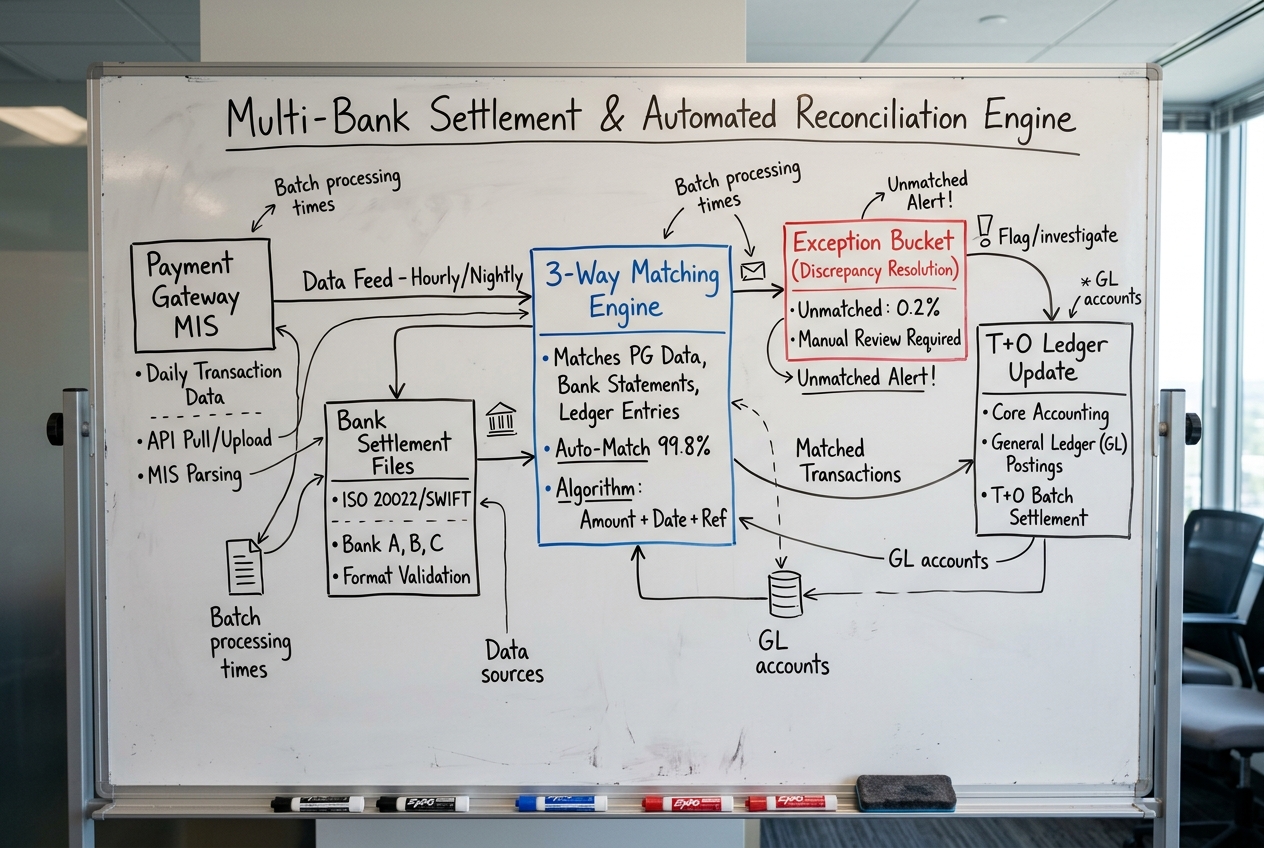
As illustrated in the hand-drawn technical architectural whiteboard blueprint above, an enterprise reconciliation engine integrates four decoupled data pipelines:
- Payment Gateway MIS Ingestion Pipeline: Automated SFTP and API parsers fetching hourly and nightly MIS files (CSV, XLSX, JSON) from payment gateways.
- Bank Settlement File Ingestion (ISO 20022 / SWIFT): Standardized ingestion connectors processing raw bank statement feeds, MT940 / CAMT.053 files, and Nodal/Escrow bank credits.
- 3-Way Matching Engine: The core algorithmic processing layer comparing Internal Transaction Logs vs. Payment Gateway MIS vs. Bank Settlement Credit Statements.
- Exception Bucket & Discrepancy Manager: Real-time flagging system capturing the remaining 0.2% unmatched or short-settled transactions for automated investigation and GL posting.
- T+0 General Ledger (GL) Updater: Automated accounting service updating core ledger accounts and posting verified settlement batches to merchant wallets.
3. The 3-Way Matching Algorithm
The 3-way matching engine executes a deterministic 3-tier hash matching sequence on every transaction record:
Step 1: Primary Key Match
   Internal RRR / Order ID == Gateway Transaction ID == Bank UTR / Reference Number

Step 2: Value & MDR Validation
   Net Settlement Amount == (Gross Transaction Amount - Applicable MDR Fee - GST)

Step 3: Temporal Window Match
   Timestamp Delta < Allowed Settlement Window (T+0 or T+1 Cut-off)
4. Handling Discrepancies: The Exception Bucket Pipeline
| Discrepancy Type | Root Cause | Automated Resolution Action |
|---|---|---|
| Captured but Unsettled | PG status is Success, but missing in Bank Statement file. | Flag for T+1 settlement window check; auto-raise PG support ticket if delayed > 48h. |
| MDR Variance | Acquirer deducted higher MDR rate than contracted rate. | Calculate variance delta; post to Commercial Dispute Ledger and notify Finance Ops. |
| Unclaimed Credit | Bank credit received without matching internal transaction log. | Move to Suspense GL; initiate asynchronous callback check with gateway gateway logs. |
5. Engineering Best Practices for Enterprise Recon
- Stream Processing with Kafka: Process incoming settlement files using event streams to maintain real-time T+0 visibility.
- Immutable Audit Trails: Store all matched and unmatched transaction logs in append-only database tables for regulatory compliance.
- Automated Dispute Workflows: Auto-generate CSV discrepancy files formatted for direct upload to acquirer bank dispute portals.
6. Conclusion
An automated multi-bank reconciliation engine turns complex financial data streams into precise, audit-ready ledger accounting. By achieving 99.8% automated matching, Indian enterprises eliminate manual overhead and ensure 100% financial accuracy.
1. मल्टी-बैंक सेटलमेंट रिकंसीलिएशन की वित्तीय वास्तविकता
उच्च-मात्रा वाले डिजिटल वाणिज्य में, कई पेमेंट गेटवे (PGs) और एक्वायरर बैंकों में लेनदेन को प्रोसेस करने से जटिल डेटा विखंडन पैदा होता है। प्रत्येक भुगतान मोड — UPI, क्रेडिट कार्ड, डेबिट कार्ड, नेट बैंकिंग, AePS, और BBPS — अपनी स्वयं की दैनिक सेटलमेंट फ़ाइलें, लेनदेन MIS रिपोर्ट और MDR शुल्क संरचनाएं उत्पन्न करता है। प्रतिदिन लाखों लेनदेन संसाधित करते समय, मैन्युअल एक्सेल रिकंसीलिएशन से राजस्व का नुकसान, एकत्र न किए गए चार्जबैक और विलंबित T+0 मर्चेंट भुगतान होता है।
एक स्वचालित मल्टी-बैंक रिकंसीलिएशन इंजन का निर्माण 99.8% स्वचालित मिलान दर प्राप्त करता है, जो वास्तविक समय में विसंगतियों को समर्पित अपवाद बाल्टी (Exception Buckets) में अलग करता है।
2. कोर आर्किटेक्चरल घटक
जैसा कि ऊपर दिए गए व्हाइटबोर्ड आरेख में दिखाया गया है, एक एंटरप्राइज रिकंसीलिएशन इंजन 4 असंबद्ध डेटा पाइपलाइनों को एकीकृत करता है:
- पेमेंट गेटवे MIS इनजेसन पाइपलाइन: पेमेंट गेटवे से प्रति घंटा और रात्रिकालीन MIS फ़ाइलें (CSV, XLSX, JSON) प्राप्त करने वाले स्वचालित SFTP और API पार्सर।
- बैंक सेटलमेंट फ़ाइल इनजेशन (ISO 20022 / SWIFT): मानकीकृत कनेक्टर जो बैंक स्टेटमेंट फ़ीड, MT940 / CAMT.053 फ़ाइलों और नोडल/एस्क्रो बैंक क्रेडिट को संसाधित करते हैं।
- 3-वे मैचिंग इंजन: मुख्य एल्गोरिथम प्रोसेसिंग परत जो आंतरिक लेनदेन लॉग बनाम पेमेंट गेटवे MIS बनाम बैंक सेटलमेंट क्रेडिट विवरण की तुलना करती है।
- एक्सेप्शन बकेट एवं विसंगति प्रबंधक: स्वचालित जांच और जनरल लेजर (GL) पोस्टिंग के लिए शेष 0.2% अमिलित या कम-सेटल किए गए लेनदेन को कैप्चर करने वाला रीयल-टाइम सिस्टम।
- T+0 जनरल लेजर (GL) अपडेटर: मुख्य खाता खातों को अपडेट करने और मर्चेंट वॉलेट में सत्यापित सेटलमेंट बैच पोस्ट करने वाली स्वचालित लेखा सेवा।
3. 3-वे मैचिंग एल्गोरिदम (Step-by-Step)
3-वे मैचिंग इंजन प्रत्येक लेनदेन रिकॉर्ड पर 3-स्तरीय हैश मिलान अनुक्रम निष्पादित करता है:
चरण 1: प्राथमिक कुंजी मिलान (Primary Key Match)
   आंतरिक RRR / ऑर्डर ID == गेटवे लेनदेन ID == बैंक UTR / संदर्भ संख्या

चरण 2: मान एवं MDR सत्यापन (Value & MDR Validation)
   शुद्ध सेटलमेंट राशि == (सकल लेनदेन राशि - लागू MDR शुल्क - GST)

चरण 3: समय विंडो मिलान (Temporal Window Match)
   टाइमस्टैम्प अंतर < अनुमत सेटलमेंट विंडो (T+0 या T+1 कट-ऑफ)
4. विसंगतियों का प्रबंधन: एक्सेप्शन बकेट पाइपलाइन (Discrepancy Table)
| विसंगति का प्रकार | मूल कारण (Root Cause) | स्वचालित समाधान कार्रवाई |
|---|---|---|
| कैप्चर किया गया लेकिन अनसैटल | PG स्थिति सफलता है, लेकिन बैंक विवरण फ़ाइल में अनुपस्थित है। | T+1 सेटलमेंट जांच के लिए फ़्लैग करें; 48 घंटे से अधिक देरी होने पर ऑटो टिकट रेज करें। |
| MDR अंतर (MDR Variance) | बैंक ने अनुबंधित दर से अधिक MDR शुल्क काटा। | अंतर की गणना करें; वाणिज्यिक विवाद लेजर में पोस्ट करें और वित्त टीम को सूचित करें। |
| दावा न किया गया क्रेडिट (Unclaimed Credit) | आंतरिक लॉग के बिना बैंक जमा प्राप्त हुआ। | उचंत खाते (Suspense GL) में स्थानांतरित करें; कॉलबैक जांच शुरू करें। |
5. एंटरप्राइज रिकंसीलिएशन के लिए सर्वोत्तम प्रथाएं
- Kafka के साथ स्ट्रीम प्रोसेसिंग: वास्तविक समय T+0 दृश्यता बनाए रखने के लिए ईवेंट स्ट्रीम का उपयोग करके सेटलमेंट फ़ाइलों को प्रोसेस करें।
- अपरिवर्तनीय ऑडिट ट्रेल्स: अनुपालन के लिए सभी मिलान किए गए और अमिलित लेनदेन लॉग को केवल-जोड़ने वाली डेटाबेस तालिकाओं में संग्रहीत करें।
- स्वचालित विवाद वर्कफ़्लो: बैंक विवाद पोर्टलों पर अपलोड करने के लिए स्वरूपित CSV विवाद फ़ाइलें स्वचालित रूप से उत्पन्न करें।
6. निष्कर्ष
एक स्वचालित मल्टी-बैंक रिकंसीलिएशन इंजन जटिल वित्तीय डेटा को सटीक, ऑडिट-रेडी लेजर अकाउंटिंग में बदल देता है। 99.8% स्वचालित मिलान प्राप्त करके, भारतीय उद्यम मैन्युअल ओवरहेड को समाप्त करते हैं और 100% वित्तीय सटीकता सुनिश्चित करते हैं।