
Building the Future of Finance: API-Driven Neobanking Architectures
Explore how modern fintechs and enterprises launch prepaid cards, digital wallets, and virtual accounts using banking APIs.
Paisape Engineering
Engineering · 17 August 2026
The Shift from Legacy Banking to Modular Finance
For decades, launch times for new financial products were measured in years. Fintechs wanting to offer simple ledger accounts or debit cards had to negotiate directly with conservative commercial banks, integrate with archaic mainframe databases, and build custom middleware to bridge modern web protocols with legacy ISO 8583 banking protocols. This high barrier to entry kept innovation slow and costly.
Today, the landscape is completely transformed by the rise of Neobanking and API-driven "Banking-as-a-Service" (BaaS). By decoupling the banking core from the user experience, banking APIs enable non-financial companies, SaaS platforms, and digital startups to launch fully branded card, credit, wallet, and ledger services in a matter of weeks. The complexity of regulatory licenses, compliance, and ledger reconciliation is abstracted away behind simple REST APIs and webhooks.
Deconstructing the Neobanking Architecture
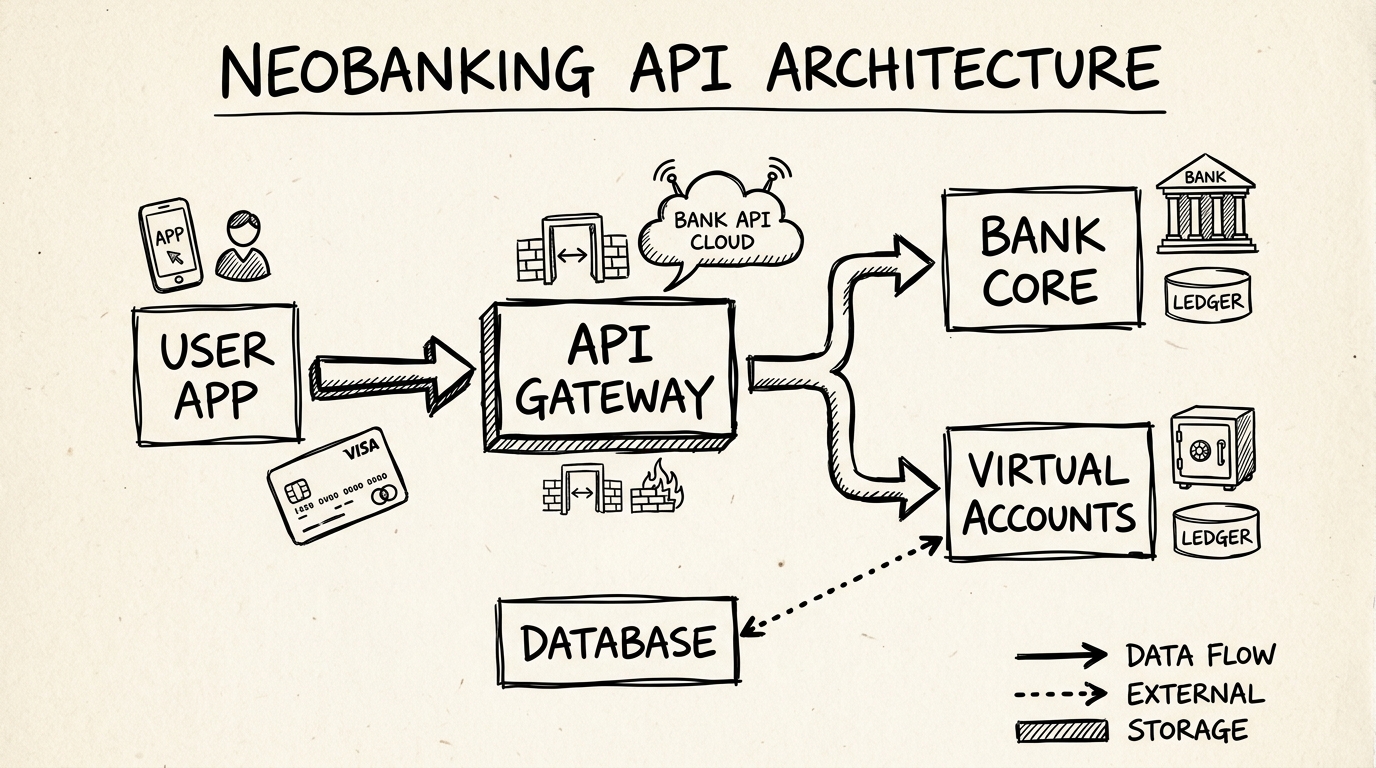
A modern neobanking system is built on a highly modular, service-oriented architecture. Instead of a monolithic system, the platform is split into distinct functional layers that interact asynchronously. Let's look at the core components:
- The Client Applications: The customer-facing web and mobile apps. They are completely decoupled from the backend and interact exclusively via APIs.
- The API Gateway: A security and routing layer that handles authentication, rate limiting, and request logging. It acts as the entrance to the system, exposing RESTful endpoints to the frontend while routing requests to internal microservices.
- The Neobank Middleware: This is where the business logic resides. It coordinates user onboarding (KYC), card controls, transaction routing, ledger updates, and fraud prevention engines.
- The Virtual Account & Ledger Engine: A double-entry bookkeeping ledger that operates in real-time. It tracks balances, user profiles, and logs immutable transaction records, ensuring complete auditability.
- The Partner Bank Core: The underlying regulated financial institution that holds the actual physical deposits. The neobank acts as an agent, using APIs to sync the virtual accounts with the bank's core banking systems (CBS).
The Mechanics of a Real-Time API Transaction
To understand the speed and efficiency of this architecture, let's trace what happens when a user executes a payment using a neobank-issued card at a merchant terminal:
First, the card swipe initiates an authorization request. The merchant's card terminal sends this transaction request to the card network (like Mastercard or Visa). The network identifies the issuer IIN (Institution Identification Number) and routes the request to the neobank's processor.
Second, the processor sends a real-time HTTP POST request (often called an authorization webhook) to the neobank's middleware. The middleware's fraud engine instantly evaluates the request based on rules (e.g., location mismatches, transaction limits, and user card locks).
Third, if approved, the ledger engine queries the database to verify if the user's virtual account has sufficient balance. If successful, the ledger locks the funds (putting them in a pending state) and replies with an HTTP 200 SUCCESS code to the processor. The processor forwards this response back to the card network, approving the transaction at the POS terminal in under 200 milliseconds.
Finally, settlement occurs asynchronously at the end of the day, where the partner bank clears the funds and updates the master physical ledger to match the neobank's virtual database records.
Compliance, Security, and Fraud Management
Building a neobank isn't just about writing neat code; it is deeply about managing risk and maintaining security. Because neobanks process sensitive transaction data, they must adhere to strict security standards like Bank-Grade Security (Payment Card Industry Data Security Standard) to ensure cardholder data is always encrypted in transit and at rest.
Additionally, modern banking APIs employ robust security mechanisms like OAuth 2.0 with Mutual TLS (mTLS) to secure machine-to-machine communication between the neobank middleware and partner bank switches. This prevents unauthorized third parties from spoofing banking requests.
On the compliance side, neobanks use automated KYC/AML (Know Your Customer / Anti-Money Laundering) pipelines during user signups. Verification APIs connect to government registries (like PAN card databases) and run automated facial matching algorithms to verify identity in seconds, minimizing onboarding drop-offs while preventing identity theft.
The Road Ahead: Embedded Finance
We are moving from a world of "finance as a destination" to "finance as a feature." In the coming years, we will see banking services embedded directly into non-financial software. Food delivery apps will offer immediate credit lines to restaurants, payroll platforms will issue early salary advance cards, and logistics networks will embed fuel wallets directly into drivers' route mapping apps.
For developers, the challenge is building scalable, zero-downtime, and highly secure API layers that can act as the glue between these various services. By mastering the core principles of API-driven banking architectures, fintech engineers can create the next wave of accessible, decentralized financial tools.