Nodal Accounts and Settlement Cycles
Understanding the RBI guidelines on merchant payouts and money flow.
Paisape Engineering
Engineering · 12 August 2026
The Architecture of Trust in Fintech
In the complex ecosystem of digital payments, money rarely moves directly from a customer's bank account to a merchant's pocket. It traverses a web of payment gateways, acquiring banks, card networks, and settlement systems. With thousands of crores of rupees in transit at any given moment, ensuring that these funds are not misappropriated, delayed, or co-mingled with operational capital is a paramount regulatory concern. This is where the concept of Nodal Accounts becomes the bedrock of fintech compliance and operational integrity.
At Paisape, handling large volumes of transaction data is only half the battle; managing the physical flow of money in strict accordance with the Reserve Bank of India (RBI) guidelines dictates our entire settlement architecture. Understanding the mechanics of Nodal accounts, escrow mechanisms, and settlement cycles is crucial for any engineer building scalable financial infrastructure.
Why Nodal Accounts Exist: Ring-Fencing the Funds
Historically, an intermediary (like an early-stage payment gateway or an e-commerce marketplace) might receive customer payments into its own corporate bank account before dispersing those funds to the actual merchants or sellers. This created massive systemic risk. If the intermediary went bankrupt, faced a liquidity crisis, or simply decided to abscond, the merchants would be left unpaid, despite having delivered the goods or services.
To eliminate this risk, the RBI mandates that all payment aggregators and intermediaries must route collected funds through a highly regulated "Nodal Account" or "Escrow Account."
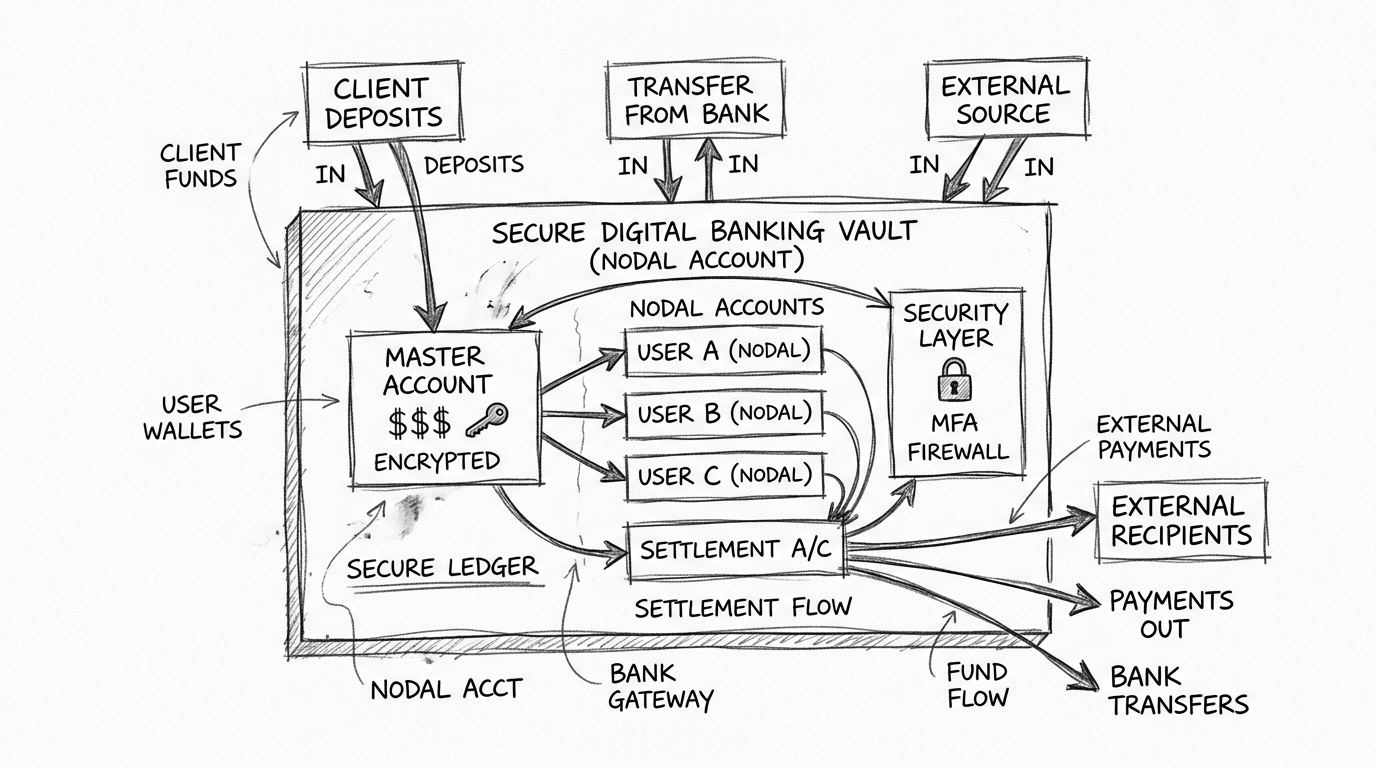
A Nodal Account is a special internal account set up by a sponsor bank. Its defining characteristic is that it is strictly ring-fenced. The funds inside a Nodal account do not belong to the payment aggregator (like Paisape); they belong to the merchants. The payment aggregator cannot use these funds for its own operational expenses, payroll, or investments. The account operates under strict debits and credits rules monitored by the sponsor bank and audited regularly to ensure that every rupee entering the account matches a rupee exiting it (minus agreed-upon fees).
The Mechanics of Settlement: T+1 and Beyond
The journey of a payment involves two distinct phases: Authorization and Settlement. When a customer makes a purchase, the transaction is authorized in real-time—the funds are locked in the customer's account, and the merchant is notified of the success. However, the actual transfer of money takes longer.
Standard settlement in the Indian payment ecosystem follows a T+1 cycle (Transaction Day + 1 Business Day). Here is how the flow typically operates:
- Day T (Transaction Day): The customer makes a payment. The acquiring bank processes the transaction and captures the funds.
- Day T+1 (Settlement Day): The acquiring bank deposits the consolidated funds into Paisape's Nodal Account.
- Day T+1 (Payout): Paisape's systems automatically calculate the net settlement amount for each merchant (Total Sales - Payment Gateway Fees - Taxes) and initiate payouts from the Nodal Account to the merchants' respective current accounts.
This strict T+1 schedule ensures that merchants receive their funds promptly while allowing sufficient time for the banking networks to clear the funds. Delays beyond T+1 are heavily penalized by the regulator to protect merchant cash flows.
The Illusion of T+0 (Instant Settlement)
In a highly competitive market, many payment aggregators offer "Instant Settlement" or T+0 settlement to their merchants. This feature allows merchants to access funds within minutes or hours of a transaction, rather than waiting for the next business day.
From an engineering and regulatory perspective, it is critical to understand that true T+0 settlement from the banking networks does not exist at scale. The acquiring banks will still only deposit funds into the Nodal account on T+1. So, how is instant settlement achieved?
T+0 settlement is essentially a short-term credit facility provided by the payment aggregator. To offer this, Paisape maintains a separate pool of its own corporate capital. When a merchant requests an instant payout, our system assesses the risk and, if approved, transfers the money from our corporate funds directly to the merchant. The next day, when the actual funds arrive in the Nodal account from the acquiring bank, they are used to reconcile the advance.
Building a T+0 system is an exercise in profound risk management. Engineers must build real-time fraud detection engines to prevent advancing funds for fraudulent transactions, which might later result in chargebacks. It requires complex ledger systems to track parallel balances: what the merchant has earned, what they have been advanced, and what is currently settling.
Marketplaces and the Complexity of Split Payments
The necessity of Nodal accounts becomes exponentially more complex when dealing with marketplaces (like food delivery apps, ride-sharing platforms, or e-commerce aggregators). In a marketplace transaction, a single customer payment might need to be split among multiple entities.
Consider a customer buying a Rs. 1000 product on a marketplace. That Rs. 1000 lands in the Nodal account. According to the platform's business logic, Rs. 800 might belong to the seller, Rs. 100 to a delivery partner, and Rs. 100 represents the marketplace's commission.
Our settlement engines must process these split logic rules in real-time. The Nodal account must programmatically disburse the funds accurately to the seller and the delivery partner, while simultaneously moving the platform's commission out of the Nodal account and into the marketplace's corporate account. This requires a robust, double-entry ledger system embedded within our core architecture to ensure that every fractional rupee is accounted for and that the Nodal account balance remains perfectly reconciled at the end of every day.
In conclusion, while the average user sees a payment as a simple instantaneous event, the backend reality is governed by strict compliance, sophisticated ledgers, and carefully timed batch processing. Mastering these Nodal and settlement architectures is what separates a basic payment gateway from a resilient financial infrastructure provider.