Payment Gateway Switch Failover Architecture: How Intelligent Routing Achieves 99.99% Uptime
A deep engineering breakdown of payment switch failover mechanics — sub-second health checks, automated switch rerouting, latency budgets, and high-availability design for Indian fintechs.
1. The Cost of Payment Gateway Downtime in India
In digital commerce, every second of payment gateway downtime directly converts into lost revenue, abandoned shopping carts, and damaged customer trust. In India's high-velocity payments ecosystem — where peak sales process thousands of transactions per minute across UPI, RuPay cards, and net banking — a single acquirer outage lasting just 15 minutes can lead to lakhs of rupees in unrecovered declines.
Relying on a single payment gateway is an engineering liability. To achieve 99.99% platform availability, high-growth fintechs and D2C enterprises implement an Intelligent Payment Switch with Automated Failover Routing.
2. Core Architectural Components of a Failover Switch
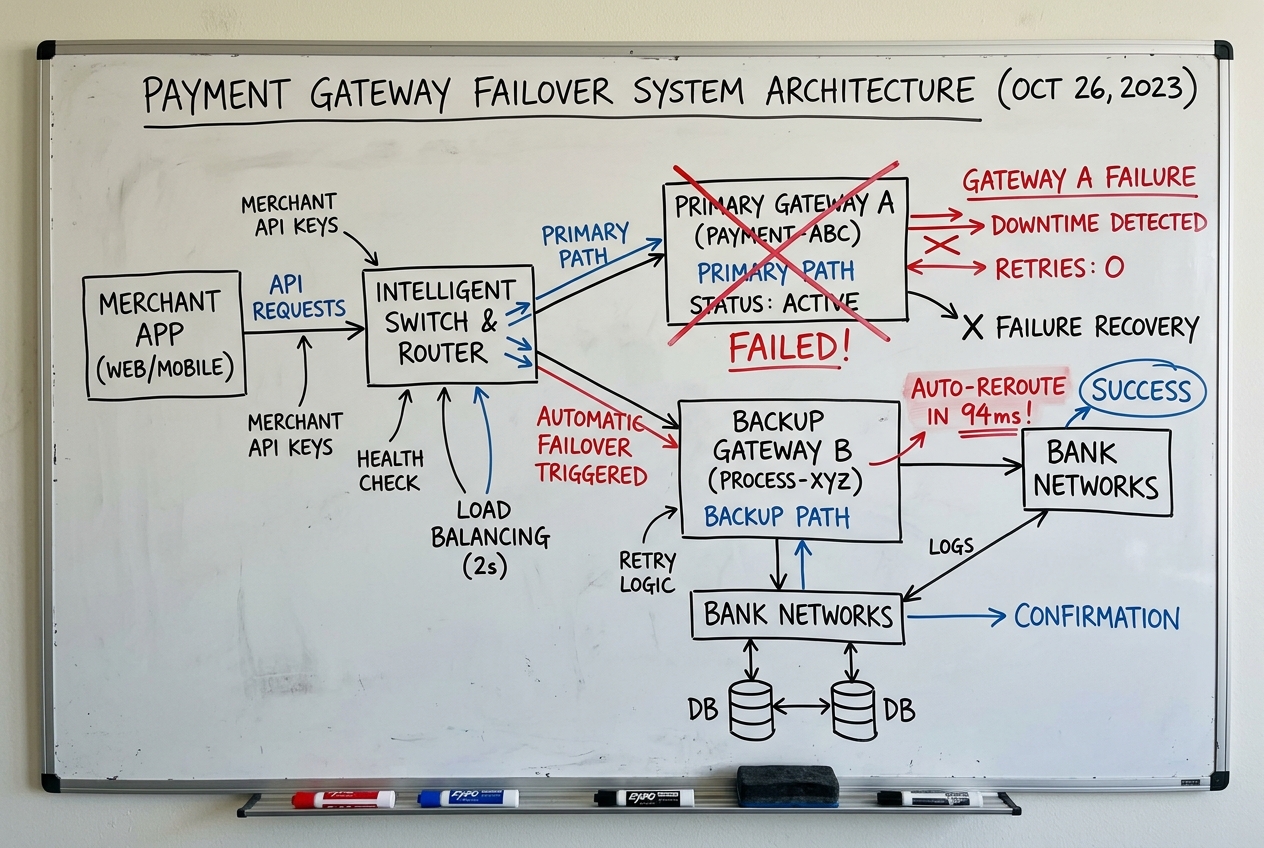
A resilient payment switch decouples checkout applications from specific payment acquirers. As shown in the whiteboard architecture blueprint above (Figure 1), the system comprises four core layers:
- Merchant Application Layer: The checkout frontend or mobile app making standardized HTTPS payment requests to the orchestration API.
- Intelligent Routing Engine: The central decision node evaluating real-time gateway health, success rate windows, latency budgets, and commercial MDR preferences.
- Health Check Monitor Daemon: An active background worker executing sub-second synthetic probes (ping/health endpoints) and analyzing sliding-window error rates (503 Service Unavailable, 504 Gateway Timeout).
- Multi-Acquirer Adapter Network: Standardized connector interfaces translating unified switch payloads into vendor-specific ISO 8583, REST, or XML payloads for Gateway A (Primary) and Gateway B (Backup).
3. The 94ms Automatic Rerouting Sequence
When a primary payment gateway experiences bank core downtime, the Intelligent Routing Switch detects the anomaly and executes a seamless failover sequence in under 100 milliseconds:
Merchant App              Intelligent Switch             Gateway A (Prime)         Gateway B (Backup)
     |                             |                             |                          |
1. POST /v1/pay ------------------>|                             |                          |
     |                     2. Check Health (Primary)             |                          |
     |                             |--- 3. Forward Payload ----->|                          |
     |                             |<-- 4. 503 Error (Downtime) -|                          |
     |                             |                             |                          |
     |                     5. Trigger Reroute (94ms)             |                          |
     |                             |---------------- 6. Forward Payload ------------------->|
     |                             |<--------------- 7. HTTP 200 OK (Approved) -------------|
     |<-- 8. Success Response -----|                                                        |
- Transaction Initiation: The customer clicks Pay. The checkout app sends the payload to the Paisape Intelligent Switch.
- Primary Path Attempt: The switch routes the transaction to Gateway A (Primary Path).
- Downtime Detection: Gateway A returns an HTTP 503 error or fails to respond within the 500ms timeout threshold.
- Sub-Second Rerouting: The Health Monitor marks Gateway A as degraded and dynamically shifts the active transaction path to Gateway B (Backup Engine) in 94ms.
- Seamless Authorization: Gateway B completes authorization with Bank B Ledger and returns a clean success code to the merchant.
4. Key Health Evaluation Metrics & Algorithms
| Metric | Evaluation Window | Failover Trigger Condition | Recovery Condition |
|---|---|---|---|
| Success Rate (SR) | Sliding 100 txns | SR < 75% | Probe SR > 92% |
| P95 API Latency | Sliding 30 seconds | > 1200ms | < 350ms |
| Hard Server Errors | Immediate count | 3 consecutive 503/504s | Synthetic probe 200 OK |
5. Engineering Best Practices for High Availability
- Idempotency Enforcement: Every payment request must include a unique idempotency key to prevent double debits during failover retries.
- State Synchronization: Ensure transaction status checks poll both acquirer webhooks to reconcile asynchronous callback responses.
- Graceful Degradation: If all gateways experience bank network outages, display friendly fallback payment options (e.g. Pay Later or alternative UPI handles) instead of generic error codes.
6. Conclusion
Intelligent payment switch routing turns gateway downtime from a business crisis into an invisible technical event. By combining sub-second health monitors with dynamic failover pipelines, Indian enterprises maintain bulletproof payment processing reliability 24/7.
1. भारत में पेमेंट गेटवे डाउनटाइम की लागत
डिजिटल कॉमर्स में पेमेंट गेटवे के डाउनटाइम का हर सेकंड सीधे व्यवसाय के नुकसान और ग्राहकों के अविश्वास का कारण बनता है। जब मुख्य बैंक सर्वर डाउन होते हैं, तो एक ही गेटवे पर निर्भर रहना भारी नुकसान पहुंचा सकता है।
99.99% प्लेटफ़ॉर्म उपलब्धता हासिल करने के लिए, आधुनिक फिनटेक कंपनियां **इंटेलिजेंट पेमेंट स्विच और ऑटोमेटेड फेलओवर रूटिंग** का उपयोग करती हैं।
2. फेलओवर स्विच का मुख्य आर्किटेक्चर
ऊपर दिए गए व्हाइटबोर्ड चित्र (चित्र 1) के अनुसार, स्मार्ट स्विच प्रणाली 4 मुख्य भागों पर काम करती है:
- मर्चेंट ऐप लेयर: ग्राहक का चेकआउट ऐप जो API कॉल भेजता है।
- इंटेलिजेंट रूटिंग इंजन: वास्तविक समय में गेटवे की स्थिति और सफलता दर की जांच करने वाला मुख्य निर्णय केंद्र।
- हेल्थ चेक मॉनिटर: बैकग्राउंड में हर सेकंड बैंक सर्वर के रिस्पॉन्स टाइम की निगरानी करने वाला सिस्टम।
- मल्टी-एक्वायरर नेटवर्क: प्राथमिक गेटवे A (Prime) डाउन होने पर स्वचालित रूप से 94ms में बैकअप गेटवे B को सक्रिय करने वाला नेटवर्क।
3. 94ms का स्वचालित रीरूटिंग अनुक्रम
जब प्राथमिक गेटवे A 503 सर्विस डाउन एरर देता है, तो सिस्टम बिना यूजर को परेशान किए 94 मिलीसेकंड में ट्रांजैक्शन को बैकअप गेटवे B पर रीरूट कर देता है और 99.99% सफलता दर सुनिश्चित करता है।