
SmartPOS Terminal Fleet Security: Remote Key Injection (RKI) & DUKPT
How merchant acquirers securely deploy, configure, and maintain cryptographic master keys across hundreds of thousands of Android SmartPOS terminals without manual physical intervention, meeting PCI PTS 6.x standards.
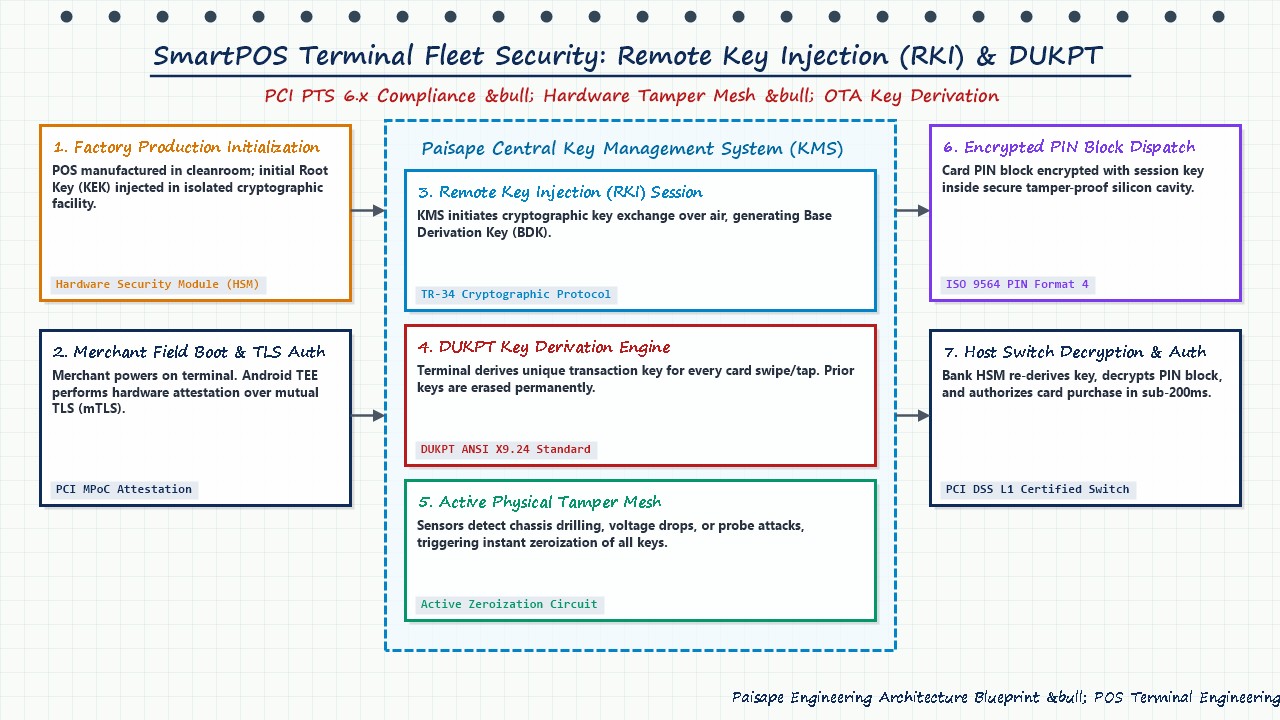
In traditional merchant acquiring, loading cryptographic keys into Point-of-Sale (POS) terminals required a "Key Injection Facility" (KIF)—a high-security physical cleanroom where certified engineers used specialized cables to load Master Keys (TMK) into each device before shipping to merchants. If a key expired or a device was redeployed to a different acquiring bank, the terminal had to be physically brought back to the facility, creating immense logistics costs and merchant downtime.
Modern Android SmartPOS terminals eliminate this bottleneck through Remote Key Injection (RKI) compliant with ANSI X9.24 and TR-34 standards, enabling secure over-the-air key provisioning straight to merchant countertops.
1. TR-34 Cryptographic Exchange & Mutual Attestation
Before any key is injected, the terminal boots into an isolated Trusted Execution Environment (TEE) or dedicated Secure Processing Unit (SPU). It establishes a mutual TLS session with Paisape’s cloud-based Hardware Security Module (HSM). The HSM validates the terminal’s factory-injected device certificate (X.509) and signs a dynamic ephemeral session token:
{
"terminalId": "PAISAPE_SP_89012",
"ksn": "98210000000000010001", // Key Serial Number
"encKeyBlock": "TR34_AES_GCM_ENCRYPTED_BDK...",
"mac": "7F8E4A0B19D2...",
"tamperStatus": "ARMED_CLEAN"
}
2. DUKPT: Unique Keys for Every Card Tap
Rather than encrypting card PIN blocks and EMV data with a static key, terminals implement Derived Unique Key Per Transaction (DUKPT). For each customer transaction, a non-reversible cryptographic algorithm computes a brand-new session encryption key and immediately increments the 21-bit transaction counter.
Once a transaction finishes, the temporary session key is wiped from memory. Even if a rogue attacker compromises a terminal’s memory months later, mathematically it is impossible to reverse-engineer past transactions.
3. Physical Tamper Mesh & Active Zeroization
Under PCI PTS 6.x guidelines, the SmartPOS mainboard is enveloped in a microscopic conductive mesh circuit. If an attacker attempts to drill through the casing to attach hardware probes to the card reader contacts, the circuit breaks. The battery-backed SPU instantly zeroizes all cryptographic memory in less than 50 nanoseconds, rendering the stolen device permanently inoperable.