
Soundbox Audio Notification Rails: Cellular SIM Telemetry & Real-Time Broadcast Architecture
A deep engineering guide to retail Soundbox terminals — MQTT telemetry pipelines, LTE-M / NB-IoT SIM data exchange, speaker-only hardware security, and sub-300ms audio alerts.
1. The Retail Soundbox Phenomenon in Indian Fintech
In India's bustling Kirana stores, street markets, and retail outlets, the Audio Soundbox has redefined payment verification. Instead of requiring merchants to check their smartphones for SMS notifications during peak business hours, Soundboxes broadcast instant, loud voice confirmations (e.g. "Paisape par 100 रुपये प्राप्त हुए") across 10+ regional Indian languages.
Behind this simple audio alert lies a high-throughput, low-latency Cellular IoT Telemetry Engine. Operating across 4G LTE-M / NB-IoT cellular SIM networks, millions of active Soundbox terminals maintain persistent TCP/MQTT socket connections to payment switches, receiving payment broadcast payloads in under 300 milliseconds.
2. Core Hardware & Telemetry Architecture
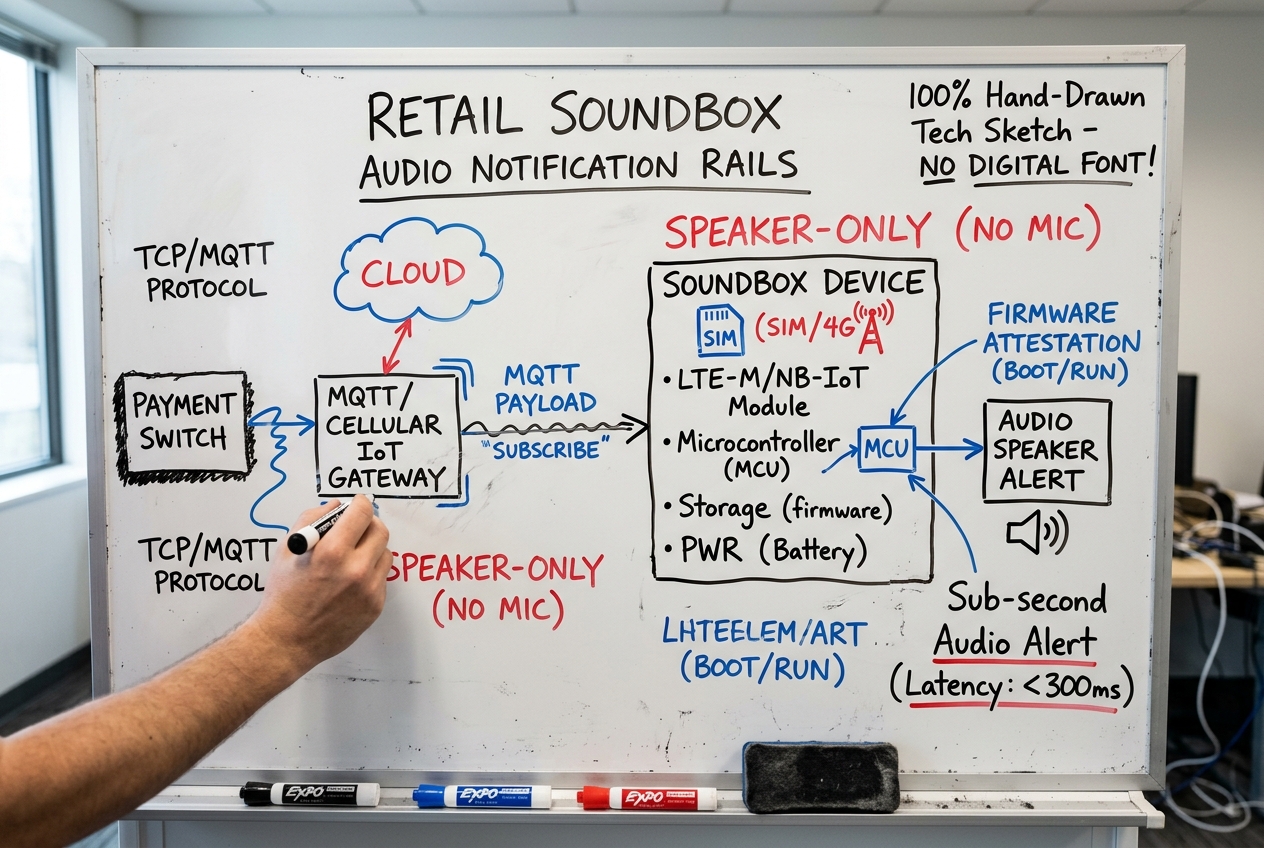
As shown in the hand-drawn technical architectural whiteboard blueprint above, a production-grade Soundbox terminal consists of four core engineering layers:
- Speaker-Only Hardware Security Mandate: To ensure strict data privacy and regulatory compliance under DPDPA, Soundbox hardware BOMs explicitly omit microphone components. The device is physically restricted to audio output only.
- Cellular SIM / Modems (LTE-M & 2G Fallback): Industrial SIM modules communicating over low-bandwidth MQTT protocols with minimal data overhead (< 1KB per broadcast).
- Microcontroller & Firmware Attestation (MCU): Embedded MCU executing cryptographically signed firmware images with secure boot validation.
- High-Decibel Speaker & Multi-lingual Audio Engine: Pre-compressed audio sample libraries stored on local SPI flash memory, triggered dynamically by MQTT payload parameters.
3. End-to-End Audio Broadcast Sequence
Customer App              NPCI / Acquirer Switch         Paisape IoT Broker           Soundbox Device (SIM)
     |                               |                            |                                |
1. Scans QR & Pays ----------------->|                            |                                |
     |                       2. Confirm Payment                   |                                |
     |                               |---- 3. Payment Webhook --->|                                |
     |                               |                            |-- 4. MQTT Push (QoS 1) ------->|
     |                               |                            |                                |-- 5. Play Voice Alert!
- Payment Confirmation: Customer scans the merchant's QR code and completes payment. The acquirer switch sends a webhook to the Paisape Payment Switch.
- MQTT Topic Routing: The IoT Gateway maps the merchant ID to the device's persistent MQTT topic (e.g.,
paisape/v1/devices/{IMEI}/alerts). - QoS Level 1 Delivery: The server publishes a lightweight JSON binary payload with Quality of Service Level 1 (QoS 1), ensuring guaranteed delivery even over spotty cellular signals.
- Instant Voice Synthesis: The device MCU receives the payload, extracts the amount and language code, and triggers pre-indexed audio phrases from local Flash RAM in < 300ms.
4. Key Hardware & Network Specifications
| Specification | Enterprise Standard | Engineering Rationale |
|---|---|---|
| Network Protocol | MQTT over TLS 1.3 | Ultra-lightweight packet size (< 200 bytes per ping) |
| Audio Latency SLA | < 300ms | Instant merchant verification before customer leaves counter |
| Hardware Security | Speaker-Only (No Mic) | Strict DPDPA compliance; zero voice listening risk |
| Battery Life | 2000mAh Li-ion (3-5 Days) | Uninterrupted operations during daily power cuts |
5. Engineering Best Practices for IoT Deployment
- Offline Buffer & Replay Prevention: Deduplicate inbound alerts using unique payment reference IDs to prevent duplicate voice broadcasts during reconnects.
- OTA Firmware Updates: Deploy Over-the-Air (OTA) firmware patches during off-peak hours (2 AM - 4 AM) using signed binary diffs.
- SIM Heartbeat Monitoring: Maintain a 60-second keep-alive ping to detect disconnected devices and trigger instant merchant app fallback notifications.
6. Conclusion
Retail Soundboxes combine rugged cellular hardware with high-availability IoT telemetry pipelines. By engineering sub-300ms broadcast latency and speaker-only security, Indian fintechs deliver effortless payment trust at the retail point of sale.
1. भारतीय फिनटेक में रिटेल साउंडबॉक्स का महत्व
भारत के हलचल भरे किराना स्टोरों, स्ट्रीट बाजारों और खुदरा दुकानों में ऑडियो साउंडबॉक्स ने भुगतान सत्यापन को पूरी तरह बदल दिया है। व्यापारियों को व्यस्त समय में SMS सूचनाओं के लिए अपने स्मार्टफोन चेक करने की आवश्यकता नहीं होती; इसके बजाय, साउंडबॉक्स 10+ क्षेत्रीय भारतीय भाषाओं में तुरंत स्पष्ट आवाज (उदा. "Paisape पर 100 रुपये प्राप्त हुए") में पुष्टि प्रसारित करता है।
इस सरल ऑडियो अलर्ट के पीछे एक उच्च-थ्रूपुट, कम-लैटेंसी सेलुलर IoT टेलीमेट्री इंजन काम करता है। 4G LTE-M / NB-IoT सेलुलर SIM नेटवर्क पर काम करने वाले लाखों साउंडबॉक्स टर्मिनल पेमेंट स्विच से निरंतर TCP/MQTT सॉकेट कनेक्शन बनाए रखते हैं और 300 मिलीसेकंड से भी कम समय में अलर्ट प्राप्त करते हैं।
2. कोर हार्डवेयर और टेलीमेट्री आर्किटेक्चर
जैसा कि ऊपर दिए गए व्हाइटबोर्ड आरेख में दिखाया गया है, एक एंटरप्राइज-ग्रेड साउंडबॉक्स टर्मिनल में 4 मुख्य इंजीनियरिंग परतें होती हैं:
- स्पीकर-ओनली हार्डवेयर सुरक्षा शासनादेश: DPDPA के तहत डेटा गोपनीयता और नियामक अनुपालन सुनिश्चित करने के लिए साउंडबॉक्स हार्डवेयर में माइक्रोफोन घटक पूरी तरह अनुपस्थित रहता है। यह उपकरण केवल ऑडियो आउटपुट तक सीमित है।
- सेलुलर SIM / मोडेम (LTE-M एवं 2G फॉलबैक): न्यूनतम डेटा ओवरहेड (< 1KB प्रति ब्रॉडकास्ट) के साथ कम-बैंडविड्थ वाले MQTT प्रोटोकॉल पर संचार करने वाले औद्योगिक SIM मॉड्यूल।
- माइक्रोकंट्रोलर एवं फर्मवेयर सत्यापन (MCU): क्रिप्टोग्राफिक रूप से हस्ताक्षरित फर्मवेयर इमेज और सुरक्षित बूट सत्यापन निष्पादित करने वाला एम्बेडेड MCU।
- उच्च-डेसिबल स्पीकर एवं बहुभाषी ऑडियो इंजन: स्थानीय SPI फ्लैश मेमोरी पर संग्रहीत प्री-कंप्रेस की गई ऑडियो फाइलें, जो MQTT पेलोड मापदंडों द्वारा गतिशील रूप से ट्रिगर होती हैं।
3. एंड-टू-एंड ऑडियो ब्रॉडकास्ट अनुक्रम
Customer App              NPCI / Acquirer Switch         Paisape IoT Broker           Soundbox Device (SIM)
     |                               |                            |                                |
1. Scans QR & Pays ----------------->|                            |                                |
     |                       2. Confirm Payment                   |                                |
     |                               |---- 3. Payment Webhook --->|                                |
     |                               |                            |-- 4. MQTT Push (QoS 1) ------->|
     |                               |                            |                                |-- 5. Play Voice Alert!
- भुगतान पुष्टि: ग्राहक QR कोड स्कैन करके भुगतान पूरा करता है। एक्वायरर बैंक स्विच Paisape पेमेंट स्विच को वेबहुक भेजता है।
- MQTT टॉपिक रूटिंग: IoT गेटवे मर्चेंट आईडी को डिवाइस के निरंतर MQTT टॉपिक (उदा.
paisape/v1/devices/{IMEI}/alerts) पर मैप करता है। - QoS लेवल 1 डिलीवरी: सर्वर क्वालिटी ऑफ सर्विस लेवल 1 (QoS 1) के साथ हल्का JSON पेलोड प्रकाशित करता है, जो कमजोर सेलुलर सिग्नल में भी गारंटीड डिलीवरी सुनिश्चित करता है।
- त्वरित वॉयस सिंथेसिस: डिवाइस MCU पेलोड प्राप्त करता है, राशि और भाषा कोड निकालता है, और < 300ms में स्थानीय फ्लैश रैम से ऑडियो संदेश बजाता है।
4. मुख्य हार्डवेयर और नेटवर्क विनिर्देश (Specifications Table)
| विनिर्देश (Specification) | एंटरप्राइज मानक | इंजीनियरिंग तर्क |
|---|---|---|
| नेटवर्क प्रोटोकॉल | MQTT over TLS 1.3 | अत्यंत हल्का पैकेट आकार (< 200 बाइट्स प्रति पिंग) |
| ऑडियो लैटेंसी SLA | < 300ms | ग्राहक के काउंटर छोड़ने से पहले त्वरित व्यापारी सत्यापन |
| हार्डवेयर सुरक्षा | केवल स्पीकर (माइक्रोफोन नहीं) | सख्त DPDPA अनुपालन; शून्य वॉयस लिसनिंग जोखिम |
| बैटरी बैकअप | 2000mAh Li-ion (3-5 दिन) | दैनिक बिजली कटौती के दौरान भी निरंतर संचालन |
5. IoT परिनियोजन के लिए सर्वोत्तम प्रथाएं
- ऑफ़लाइन बफ़र एवं रीप्ले रोकथाम: पुन: कनेक्ट होने के दौरान दोहराए गए वॉयस प्रसारण को रोकने के लिए अद्वितीय भुगतान संदर्भ आईडी द्वारा संदेशों को डि-डुप्लिकेट करें।
- OTA फर्मवेयर अपडेट: हस्ताक्षरित बाइनरी डिफ्स का उपयोग करके कम मांग वाले घंटों (रात 2 से 4 बजे) के दौरान ओवर-द-एयर (OTA) फर्मवेयर पैच तैनात करें।
- SIM हार्टबीट मॉनिटरिंग: डिस्कनेक्ट किए गए उपकरणों का पता लगाने और मर्चेंट ऐप फॉलबैक सूचनाएं ट्रिगर करने के लिए 60-सेकंड का कीप-अलाइव पिंग बनाए रखें।
6. निष्कर्ष
रिटेल साउंडबॉक्स मजबूत सेलुलर हार्डवेयर को उच्च-उपलब्धता IoT टेलीमेट्री पाइपलाइनों के साथ जोड़ता है। 300ms से कम लैटेंसी और स्पीकर-ओनली सुरक्षा के साथ, भारतीय फिनटेक खुदरा बिक्री के स्थान पर सहज विश्वास प्रदान करते हैं।