
NPCI UPI AutoPay & Recurring Mandates: VPA Binding, Token Lifecycle & Sub-Second Execution
An engineering deep-dive into NPCI UPI AutoPay architecture — mandate registration APIs, VPA tokenization, 24-hour pre-debit notification rules, recurring scheduler execution, and webhook reconciliation for Indian subscription platforms.
1. Why UPI AutoPay Has Transformed Subscription Commerce in India
Until recently, recurring payments in India relied heavily on credit card e-mandates or physical NACH paperwork — both plagued by high drop-off rates, complex authentication friction, and limited consumer adoption. The introduction of NPCI UPI AutoPay enabled over 350 million active UPI users to set up automated recurring payments directly from their preferred UPI app (PhonePe, Google Pay, Paytm, BHIM, Cred) using a single 1-step UPI PIN authorization.
From SaaS subscriptions and OTT streaming to EMI repayments, SIP mutual funds, and utility bills, UPI AutoPay handles millions of recurring transactions daily. For fintech engineers, building a compliant UPI AutoPay engine requires mastering Mandate Tokenization, Pre-Debit Notifications, and Sub-Second Execution Schedulers.
2. Core Architectural Components of UPI AutoPay
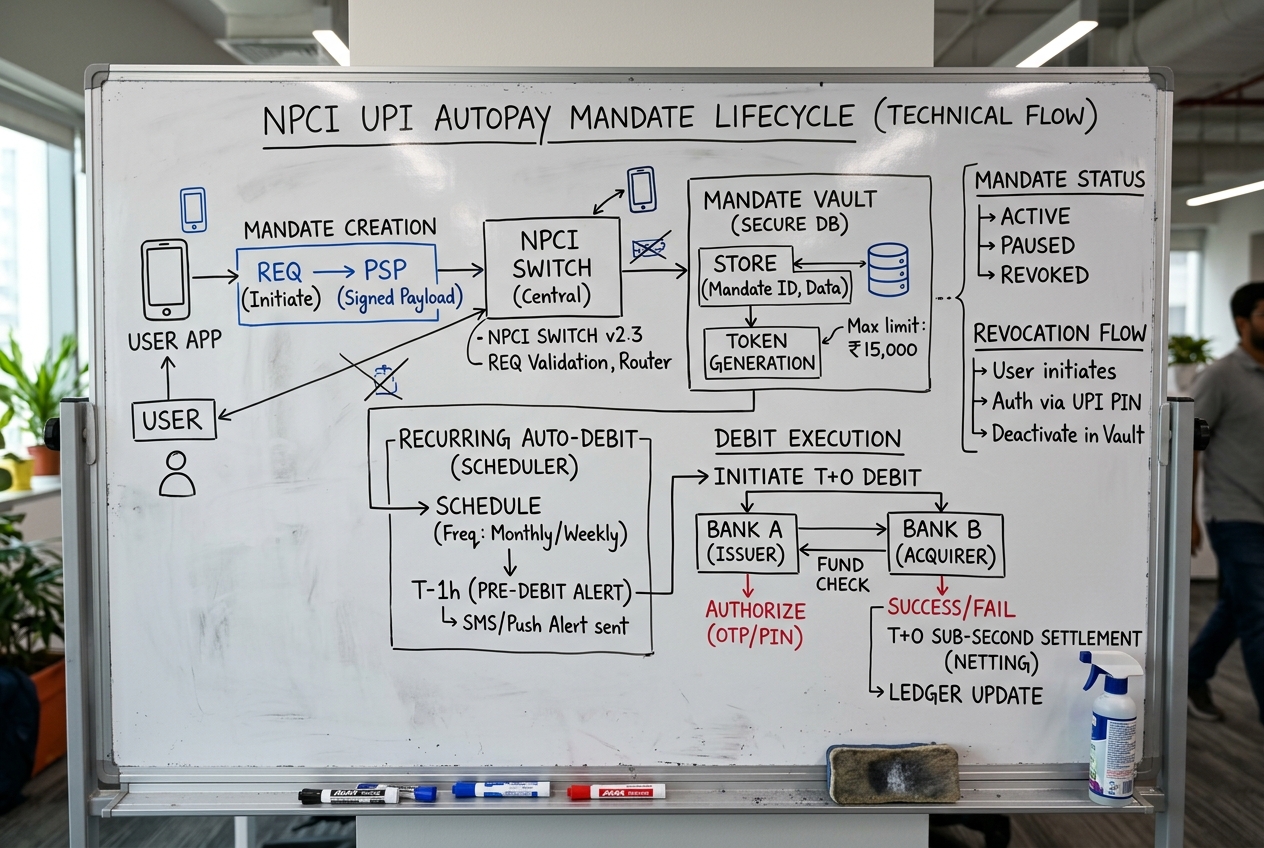
As illustrated in the hand-drawn technical architectural blueprint above (Figure 1), a production-grade UPI AutoPay engine comprises five interconnected subsystems:
- User SDK & Mandate Creation API: Captures user consent, defines mandate execution parameters (amount, frequency, start date, end date, max cap up to ₹15,000 without 2FA), and initiates the UPI Intent / Collect flow.
- NPCI Mapper & VPA Tokenizer: Validates user Virtual Payment Address (VPA e.g.,
abc@upi), requests a unique Mandate ID (UMRN) from the NPCI Switch, and binds the customer's bank account token. - Mandate Vault (Secure Token Store): A tamper-proof, append-only database logging mandate status, execution frequency (daily, weekly, monthly, as presented), authorized amount limits, and token validity dates.
- 24-Hour Pre-Debit Notification Engine: Triggers mandatory SMS / WhatsApp / Push notifications to the customer 24 hours prior to recurring debit execution as mandated by RBI.
- Auto-Debit Execution Scheduler: High-throughput cron engine executing recurring debit API requests against NPCI switches at midnight T+0 with sub-second processing speeds.
3. The 3-Phase Mandate Lifecycle
Phase A: Mandate Registration (One-Time PIN Auth)
The customer selects a subscription plan. The merchant calls the /v1/mandate/create API. The customer confirms on their UPI app by entering their 4-digit or 6-digit UPI PIN once. NPCI generates a unique **Unique Mandate Reference Number (UMRN)**.
Phase B: 24-Hour Pre-Debit Notification (Mandatory RBI Compliance)
Under RBI guidelines, the merchant must send an automated Pre-Debit Notification to the customer at least 24 hours before triggering any auto-debit. The notification includes the UMRN, debit amount, merchant name, and an instant opt-out link allowing the customer to pause or cancel the mandate.
Phase C: Execution & Settlement (Sub-Second T+0 Debit)
On the scheduled debit date, the Auto-Debit Scheduler submits the UMRN token to NPCI. Money is instantly debited from the customer's remitter bank and settled to the merchant's escrow account in sub-second time.
4. Technical Comparison: Mandate Rules & Limits
| Parameter | Standard UPI AutoPay | High-Value Mandate (SIP / EMI) |
|---|---|---|
| Max Limit per Transaction | Up to ₹15,000 (No PIN needed for recurring) | Up to ₹1,000,000 (Investments & Loans) |
| Pre-Debit Notice SLA | 24 Hours mandatory prior to debit | 24 Hours mandatory prior to debit |
| Execution Frequencies | Daily, Weekly, Monthly, As Presented | Monthly / Quarterly SIP |
| Revocation Path | 1-click in UPI App or Merchant Portal | 1-click in UPI App or Merchant Portal |
5. Engineering Guidelines & Error Handling
- Idempotency Keys: Always append a unique
requestIdon every recurring debit execution call to prevent double-charging during network retries. - Handling UMRN Revocation: Subscribe to NPCI webhook events for
MANDATE_PAUSEDorMANDATE_REVOKEDto instantly update subscription states in your CRM. - Fallback Retry Logic: If an auto-debit fails due to insufficient funds (Error Code
U51), schedule a maximum of 2 automated retry attempts spaced 48 hours apart.
6. Conclusion
UPI AutoPay provides Indian businesses with a friction-free recurring revenue engine. By automating mandate registration, enforcing pre-debit SLAs, and deploying robust Mandate Vault storage, fintechs achieve over 95% recurring debit success rates with 100% RBI compliance.
1. UPI AutoPay भारत में क्यों क्रांति ला रहा है?
UPI AutoPay के जरिए ग्राहक अपने पसंदीदा UPI ऐप (PhonePe, Google Pay, Paytm, BHIM) से केवल एक बार UPI PIN दर्ज करके मासिक सदस्यता, EMI और बिलों के लिए ऑटो-डेबिट सेट कर सकते हैं।
2. UPI AutoPay का मुख्य आर्किटेक्चर (चित्र 1)
- मैंडेट निर्माण (SDK/API): ग्राहक द्वारा ₹15,000 तक की अधिकतम सीमा के साथ मैंडेट बनाना।
- NPCI मैपर और टोकनाइजेशन: यूनिक मैंडेट आईडी (UMRN) प्राप्त करना और बैंक खाते को टोकनाइज करना।
- 24-घंटे पूर्व सूचना (RBI नियम): ऑटो-डेबिट से ठीक 24 घंटे पहले ग्राहक को SMS/व्हाट्सएप के जरिए पूर्व सूचना भेजना अनिवार्य।
- ऑटो-डेबिट शेड्यूलर: निर्धारित तिथि पर बिना PIN के sub-second समय में राशि काटना।
3. निष्कर्ष
मजबूत मैंडेट वॉल्ट और प्री-डेबिट अलर्ट के साथ UPI AutoPay भारतीय फिनटेक और SaaS व्यवसायों को 95%+ की आवर्ती भुगतान सफलता दर प्रदान करता है।