
UPI Lite X & Offline Payments: Technical Mechanics, On-Device Wallets & NFC Infrastructure
A complete engineering guide to NPCI UPI Lite X — offline wallet architecture, Secure Element (SE) storage, NFC peer-to-peer data exchange, and batch sync settlement.
1. Why Offline UPI Matters in India
While online UPI processes over 14 billion transactions monthly, cellular network congestions in underground metros, crowded sports stadiums, remote rural regions, and basement parking lots remain a major bottleneck for small-value merchant payments. To solve this, NPCI introduced UPI Lite X — allowing payments to be executed cleanly even when both the sender and receiver have zero cellular signal or internet connection.
2. Technical Architecture: How UPI Lite X Works Offline
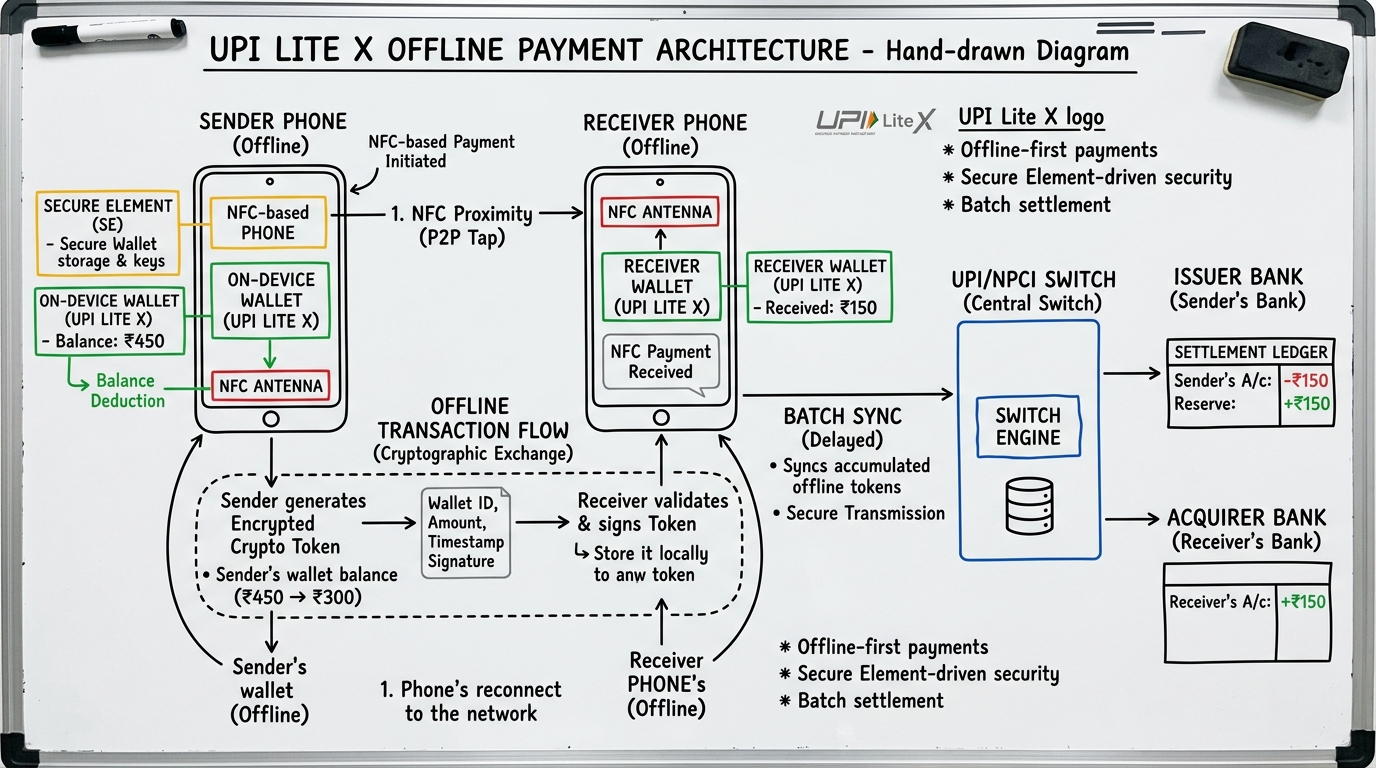
UPI Lite X replaces the online bank-switch roundtrip with an on-device cryptographic token exchange via Near Field Communication (NFC):
- On-Device Secure Element (SE): The user's phone maintains a secure, tamper-proof wallet partition inside the hardware enclave (TEE/SE) containing pre-funded balance tokens.
- Zero PIN Requirement: Small-value transactions (up to ₹500 per payment) execute instantly without requiring a UPI PIN, reducing latency to under 200 milliseconds.
- P2P NFC Proximity Protocol: Payments occur by tapping two phones together or tapping a merchant's offline Soundbox/POS terminal.
3. Cryptographic Token Generation & Peer-to-Peer Exchange
The offline transaction sequence operates in three distinct phases:
Sender Device (Offline)              Receiver Device (Offline)              NPCI / Bank Switch
   [Secure Element]                    [Secure Element]                        [Cloud Switch]
        |                                     |                                      |
1. Tap Phones (NFC) ------------------------->|                                      |
2. Encrypted Token (Wallet ID, Amt, Sig) ---->| Save Token to Local Queue            |
3. Balance Updated (₹500 -> ₹300)             |                                      |
                                              |-- 4. Net Sync (When Online) -------->|
                                              |                               5. Batch Ledger
                                              |                                  Settlement
- Pre-Funding: When online, the user loads up to ₹2,000 into their UPI Lite X wallet from their bank account. The bank locks this amount in a dedicated escrow account.
- Offline Tap: Sender taps receiver's phone via NFC. Sender's app generates a cryptographically signed payload containing
WalletID,TransactionSeq,Amount,Timestamp, and an HMAC payload signed by the hardware key. - Local Validation: Receiver's Secure Element verifies the signature and sequence counter. Sender's local wallet balance is debited immediately on-device.
- Asynchronous Batch Sync: When either phone reconnects to cellular/Wi-Fi networks, the queued signed tokens are uploaded to NPCI for batch clearing and final bank account settlement.
4. Fraud Prevention & Security Safeguards
- Double-Spend Prevention: Strict monotonically increasing sequence counters backed by hardware keys prevent token reuse or replay attacks.
- Balance Caps: Wallet balance is strictly capped at ₹2,000 to limit risk exposure in case of physical device theft.
- Replay Attack Shielding: Timestamps expire tokens if not synced within regulatory time windows.
5. Conclusion for Engineering Teams
UPI Lite X bridges the last mile of Indian digital payments. By implementing NFC wallet APIs, offline queue managers, and robust asynchronous batch clearing pipelines, payment apps ensure zero transaction drop-offs regardless of network connectivity.
1. भारत में ऑफलाइन UPI क्यों महत्वपूर्ण है?
ऑनलाइन UPI प्रति माह 14 अरब से अधिक लेनदेन संसाधित करता है, लेकिन अंडरग्राउंड मेट्रो, स्टेडियमों और ग्रामीण इलाकों में नेटवर्क कनेक्टिविटी न होना एक चुनौती थी। NPCI ने UPI Lite X लॉन्च किया — जिससे बिना इंटरनेट के दो फोन आपस में पेमेंट ट्रांसफर कर सकते हैं।
2. UPI Lite X तकनीक कैसे काम करती है?
UPI Lite X इंटरनेट के बिना कार्य करने के लिए **Near Field Communication (NFC)** तकनीक का उपयोग करता है।
3. सुरक्षा और फ्रॉड रोकथाम
हार्डवेयर एनक्लेव और Secure Element (SE) में सुरक्षित स्टोरेज से धोखाधड़ी पूरी तरह से रुकी रहती है। ऑनलाइन आने पर बैच सिंक के जरिए बैंक खातों का सेटलमेंट पूरा होता है।