
Why your UPI success rate drops at 9 PM � and what routing can do about it
Peak-hour declines are rarely a customer problem. We pulled 40 million transactions across eight acquirers to show where the failures actually originate.
Paisape Engineering
Engineering · 12 August 2026
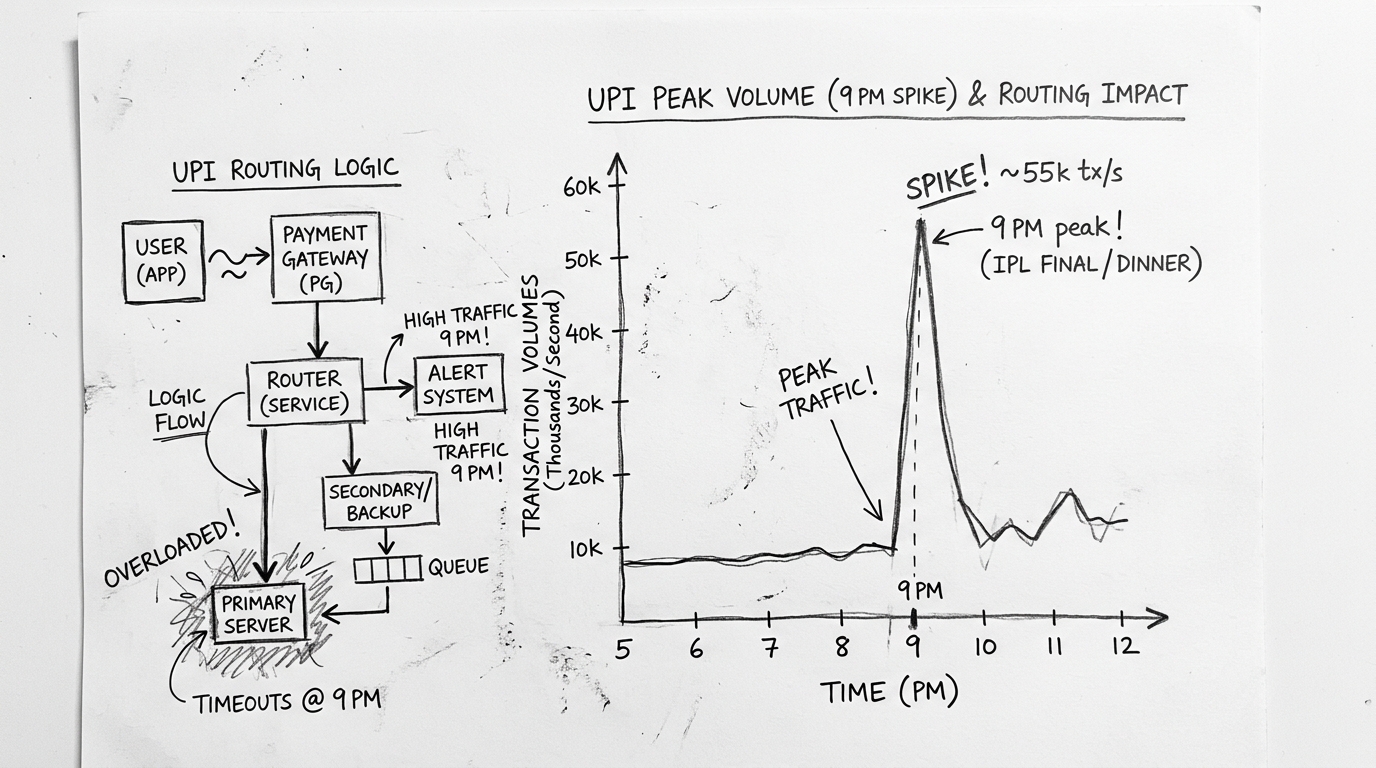
The 9 PM Traffic Spike
In India, UPI transaction volume doesn't follow a flat curve. Data across millions of transactions shows a massive spike between 8:30 PM and 9:30 PM. This is when people are dining out, ordering food, paying for cabs, and settling daily tabs. The sheer volume of concurrent requests puts immense pressure on the National Financial Switch (NFS) and individual bank Core Banking Systems (CBS).
Where the Failures Originate
When you see a dip in success rates, it's rarely a single point of failure. Our analysis of 40 million transactions reveals:
- 45% of failures: Issuer Bank CBS timeouts (The user's bank is too slow to respond).
- 30% of failures: Acquirer Bank switch congestion (The acquiring bank cannot process the incoming volume fast enough).
- 15% of failures: PSP app latency (PhonePe, GPay, etc., experiencing local network or timeout issues).
- 10% of failures: Genuine user errors (Insufficient funds, wrong UPI PIN).
How Dynamic Routing Mitigates This
A static payment gateway setup sends all traffic through a single acquiring bank (e.g., Yes Bank or ICICI). If that specific bank's switch gets congested at 9 PM, your success rate plummets from 85% to 50% instantly.
With an active orchestration layer, traffic is dynamically split. The orchestrator pings a health-check API across 4 different acquirers every second. The moment Acquirer A's latency crosses 800ms, the orchestrator routes the next batch of transactions to Acquirer B or C. This ensures that even during peak hours, your transactions find the path of least resistance.
The Optimal Retry Window
When a transaction fails due to a network timeout, immediately asking the user to retry on the same bank usually results in another failure, as the bank's CBS is still recovering. Data shows that waiting exactly 45 seconds before prompting a retry, or suggesting they use a different bank account, increases recovery rates by over 40%.