
Aadhaar eKYC vs CKYC vs V-CIP: Which KYC Method Should Your Fintech Choose?
A complete engineering guide to India's three KYC methods — Aadhaar eKYC, CKYC registry, and V-CIP video verification — with cost comparison and decision frameworks.
Paisape Engineering
Engineering · 23 August 2026
1. Why KYC Method Selection Matters
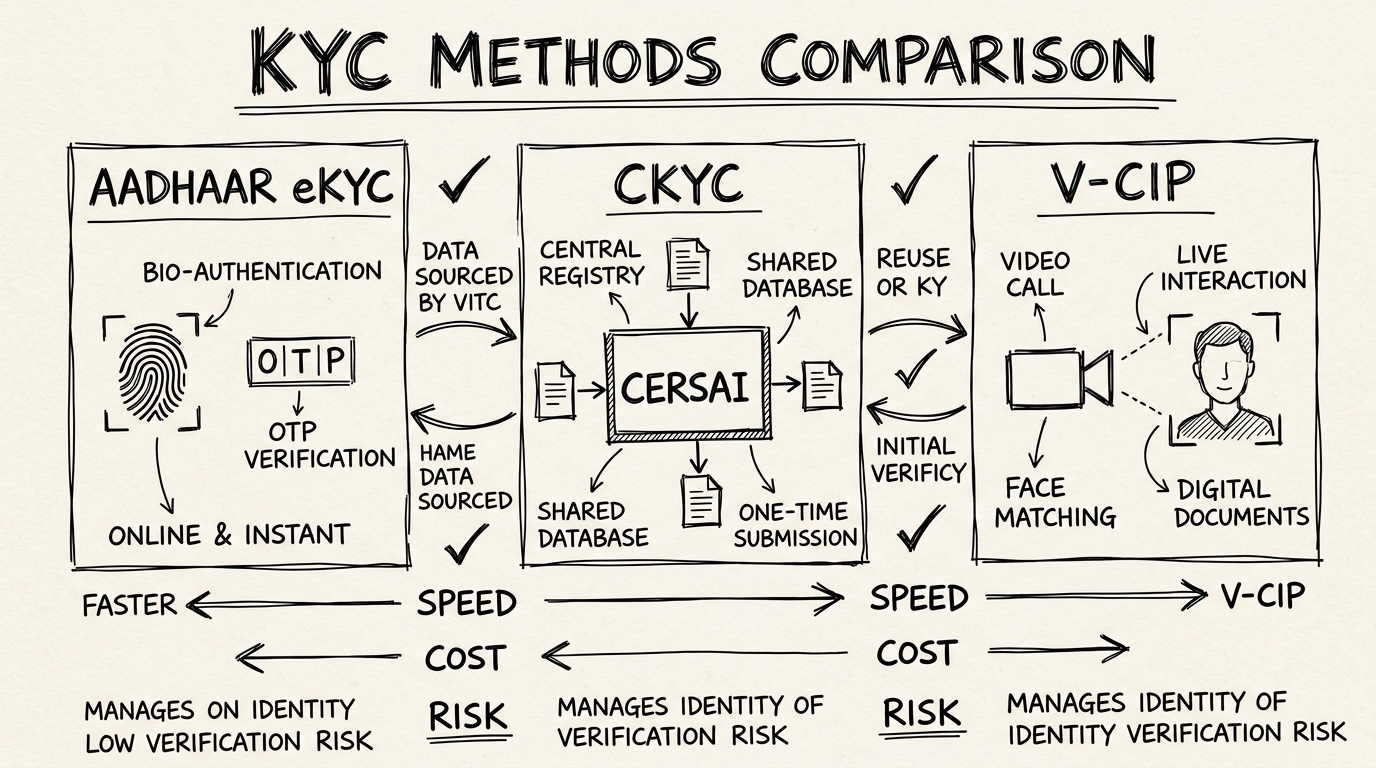
Choosing the wrong KYC method costs real money: higher per-verification API costs, longer user drop-off during onboarding, and PMLA audit failures. RBI mandates Customer Due Diligence (CDD) for every new customer but gives regulated entities three primary routes: Aadhaar eKYC, CKYC, and V-CIP. Understanding the engineering, legal, and cost trade-offs is essential product infrastructure knowledge.
2. Aadhaar eKYC — Instant, UIDAI-Backed Verification
The fastest method. Uses UIDAI's biometric database via OTP or fingerprint authentication. On user consent, UIDAI returns encrypted KYC XML with verified name, address, photo, DOB, and gender.
Key Rules
- AUA/KUA License Required: Cannot call UIDAI APIs directly. Use licensed partners (Signzy, IDfy, NSDL).
- Explicit Consent Mandatory: User must actively consent before each eKYC call.
- Aadhaar Masking: Only last 4 digits may be stored. Full 12-digit storage is illegal under the Aadhaar Act.
- DPDPA: eKYC XML is sensitive personal data — store encrypted.
- Cost: ₹3–₹8 per successful verification.
Best For: High-volume consumer onboarding (wallets, UPI, BNPL) where speed is critical.
3. CKYC — One-Time KYC, Reusable Everywhere
India's centralized KYC registry operated by CERSAI under SEBI/RBI mandate. When any regulated entity completes KYC, the record is uploaded to CKYC and the customer receives a unique 14-digit KIN. Any other regulated entity can then fetch this verified KYC record using the KIN — no re-submission needed.
Key Rules
- Mandatory Search: RBI-regulated entities must search CKYC before onboarding new customers.
- Risk Classification: Records carry Low/Medium/High risk ratings. Periodic re-KYC required for Medium/High.
- Cost: ₹1–₹3 per CKYC search/fetch.
Best For: Lending, wealth management, insurance — where customers likely already have CKYC records.
4. V-CIP — High-Assurance Video Verification
RBI's Video Customer Identification Process (January 2020). A live, recorded video call with a certified KYC officer. Essential for NRIs and customers who cannot complete Aadhaar eKYC.
Key Technical Requirements
- Video must be live and uninterrupted — pre-recorded video is prohibited.
- Real-time geo-location capture with customer consent.
- AI facial match against OVD photograph (minimum ~80% similarity).
- Full recording stored for minimum 5 years (PMLA requirement).
- Must be conducted by a certified KYC officer.
- Cost: ₹50–₹200 per verification.
Best For: NRI customers, high-value accounts, cases where eKYC fails.
5. Side-by-Side Comparison
| Factor | Aadhaar eKYC | CKYC | V-CIP |
|---|---|---|---|
| Speed | Instant (<30 sec) | Minutes (if KIN exists) | 15–30 minutes |
| Cost per Verification | ₹3–₹8 | ₹1–₹3 | ₹50–₹200 |
| Aadhaar Required | Yes + linked mobile | No (PAN/OVD) | No |
| Works for NRIs | No | Partial | Yes |
| Drop-off Risk | Low | Very Low | High |
| Regulatory Basis | UIDAI / Aadhaar Act | RBI KYC Master Directions | RBI V-CIP Guidelines 2020 |
6. The Recommended Waterfall Decision Framework
Most production fintechs implement all three as a fallback chain:
- Step 1 — CKYC Lookup First: Query CKYC with PAN. If KIN found and valid, KYC is complete at ₹1–3. Zero user friction.
- Step 2 — Aadhaar eKYC Fallback: No CKYC record? Attempt Aadhaar OTP eKYC. Covers 90%+ of Indian retail users.
- Step 3 — V-CIP Last Resort: eKYC fails (NRI, no linkage, biometric failure)? Trigger a V-CIP video session.
1. KYC Method चुनना क्यों जरूरी है?
गलत KYC तरीका वास्तविक नुकसान करता है। RBI हर नए ग्राहक के लिए Customer Due Diligence (CDD) अनिवार्य करता है लेकिन तीन मुख्य रास्ते देता है: Aadhaar eKYC, CKYC, और V-CIP।
2. Aadhaar eKYC — तत्काल सत्यापन
सबसे तेज तरीका। UIDAI के बायोमेट्रिक डेटाबेस का उपयोग OTP या फिंगरप्रिंट के माध्यम से पहचान सत्यापन के लिए करता है।
- AUA/KUA लाइसेंस आवश्यक: UIDAI APIs सीधे call नहीं कर सकते।
- स्पष्ट सहमति अनिवार्य — हर eKYC call से पहले।
- आधार मास्किंग: केवल अंतिम 4 अंक संग्रहीत किए जा सकते हैं।
- लागत: प्रति सत्यापन ₹3–₹8।
3. CKYC — एक बार KYC, हर जगह उपयोग
CERSAI द्वारा संचालित भारत की केंद्रीकृत KYC रजिस्ट्री। ग्राहक को एक 14-अंकीय KIN मिलती है जिसे कोई भी regulated संस्था fetch कर सकती है।
- RBI-regulated संस्थाओं के लिए अनिवार्य खोज।
- लागत: प्रति खोज ₹1–₹3।
4. V-CIP — वीडियो-आधारित KYC
RBI का Video Customer Identification Process (जनवरी 2020)। प्रशिक्षित अधिकारी के साथ लाइव, रिकॉर्डेड वीडियो कॉल। NRI और Aadhaar eKYC विफल होने वाले ग्राहकों के लिए आवश्यक।
- AI-assisted फेशियल मैच अनिवार्य।
- पूरी रिकॉर्डिंग 5 साल तक संग्रहीत करनी होगी।
- लागत: ₹50–₹200।
5. अनुशंसित Waterfall निर्णय ढांचा
- पहले CKYC Lookup: PAN से खोजें। KIN मिली? KYC पूर्ण।
- Aadhaar eKYC Fallback: CKYC रिकॉर्ड नहीं? Aadhaar OTP eKYC।
- V-CIP अंतिम विकल्प: eKYC विफल? वीडियो KYC सत्र।