
The Complete DPDPA Guide: Data Privacy for Indian Fintechs & Merchants
A deep dive into India's Digital Personal Data Protection Act (DPDPA), consent architectures, legal rights, statutory penalties, and compliance checklists.
Paisape Engineering
Engineering · 18 August 2026
Series Introduction
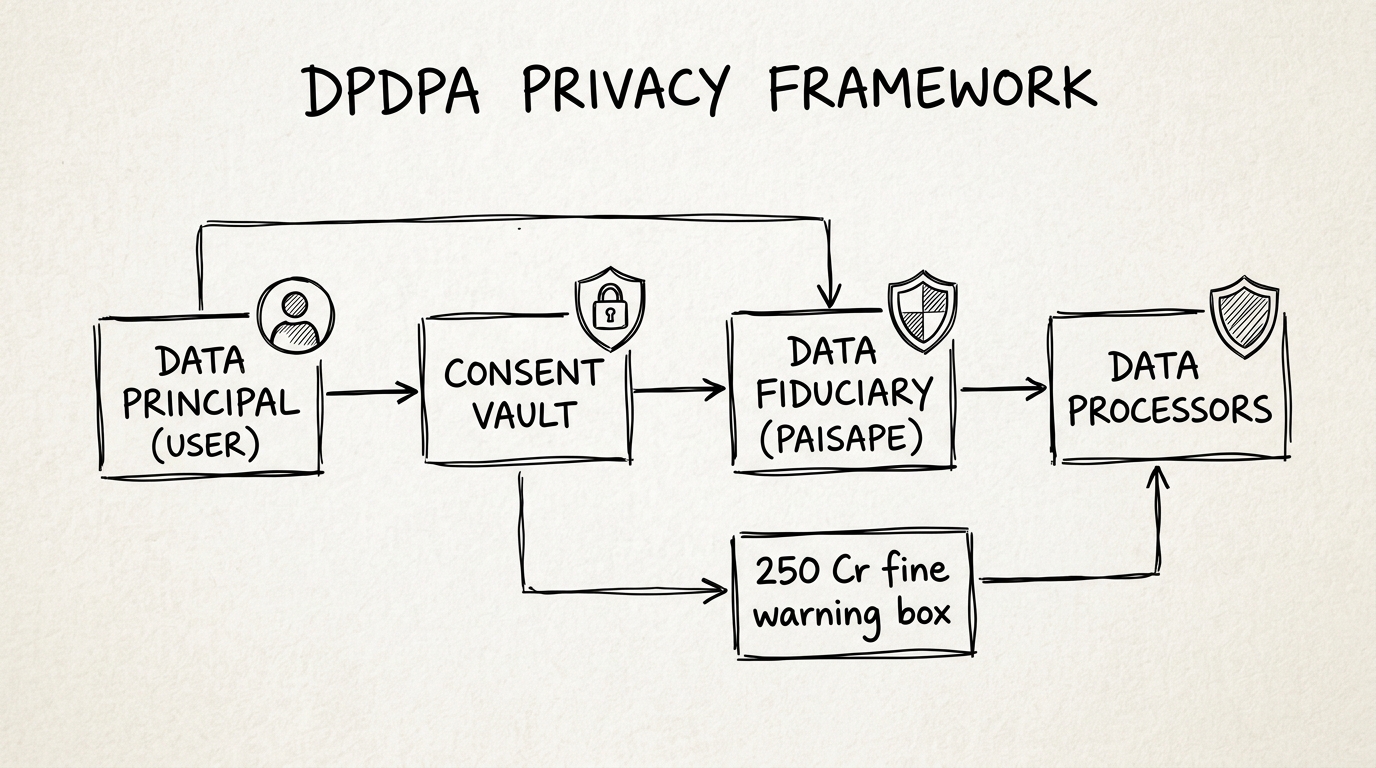
Welcome to Part 1 of the Paisape DPDPA Fintech Series. The Digital Personal Data Protection Act (DPDPA) is India's landmark data privacy framework. This introductory pillar post provides a high-level overview of the Act, key statutory roles, the non-compliance penalty matrix (up to ₹250 Crore), and an executive compliance roadmap.
1. What is the DPDPA 2023/2026?
The Digital Personal Data Protection Act (DPDPA) is India's first dedicated legislation governing digital personal data. It applies to all digital personal data collected within India, as well as data processed outside India when offering goods or services to Indian citizens.
2. Core Statutory Roles Defined
- Data Principal: The individual whose personal data is collected (cardholders, UPI users, or onboarded merchants).
- Data Fiduciary: The business entity that determines the purpose and means of data processing (e.g., Paisape or your merchant platform).
- Data Processor: Third-party entities processing data on behalf of the Data Fiduciary (cloud hosts, SMS gateways, bank switches).
- Data Protection Board of India (DPBI): The central regulatory body enforcing compliance and adjudicating breaches.
3. Non-Compliance Penalty Matrix
| Violation Type | Maximum Statutory Penalty |
|---|---|
| Failure to prevent data breach (security failure) | Up to ₹250 Crore |
| Failure to report data breach to Board / users | Up to ₹200 Crore |
| Children's data protection violations (<18 years) | Up to ₹200 Crore |
4. Executive Compliance Roadmap
- Audit all digital data ingestion points (Web, App, POS, Soundbox).
- Remove pre-ticked checkboxes and unbundle consent notices.
- Execute Data Processing Agreements (DPAs) with all third-party vendors.
- Enforce AES-256 encryption at rest and TLS 1.3 in transit.
- Appoint a Data Protection Officer (DPO) and establish a 24-hour breach response SOP.
Explore the DPDPA Deep-Dive Series
Dive into our specialized engineering and legal guides:
श्रृंखला परिचय (Series Introduction)
Paisape DPDPA फिनटेक श्रृंखला के भाग 1 में आपका स्वागत है। डिजिटल पर्सनल डेटा प्रोटेक्शन एक्ट (DPDPA) भारत का प्रमुख डेटा गोपनीयता ढांचा है। यह परिचयात्मक लेख कानून का अवलोकन, मुख्य कानूनी भूमिकाएं, गैर-अनुपालन जुर्माना सूची (₹250 करोड़ तक), और एक कार्यकारी अनुपालन रोडमैप प्रदान करता है।
1. DPDPA 2023/2026 क्या है?
डिजिटल पर्सनल डेटा प्रोटेक्शन एक्ट (DPDPA) भारत का पहला समर्पित कानून है जो डिजिटल व्यक्तिगत डेटा को नियंत्रित करता है। यह भारत के भीतर एकत्र किए गए सभी डिजिटल डेटा के साथ-साथ भारतीय नागरिकों को सेवाएं देने वाली विदेशी कंपनियों के डेटा प्रोसेसिंग पर भी लागू होता है।
2. मुख्य कानूनी परिभाषाएं
- डेटा प्रिंसिपल (Data Principal): वह व्यक्ति जिसका डेटा एकत्र किया जा रहा है (पेमेंट यूजर या मर्चेंट)।
- डेटा फिड्यूशियरी (Data Fiduciary): वह कंपनी जो तय करती है कि डेटा क्यों और कैसे एकत्र किया जाएगा (जैसे Paisape या आपका बिजनेस)।
- डेटा प्रोसेसर (Data Processor): वे वेंडर जो कंपनी के लिए डेटा प्रोसेस करते हैं (क्लाउड होस्ट, SMS गेटवे, बैंक स्विच)।
- डेटा प्रोटेक्शन बोर्ड ऑफ इंडिया (DPBI): भारत सरकार की केंद्रीय संस्था जो इस कानून का संचालन करती है।
3. कानूनी जुर्मानों की सूची (Penalty Matrix)
| उल्लंघन का प्रकार | अधिकतम कानूनी जुर्माना |
|---|---|
| डेटा लीक या चोरी रोकने में लापरवाही | ₹250 करोड़ तक |
| डेटा लीक होने पर बोर्ड या ग्राहकों को सूचना न देना | ₹200 करोड़ तक |
| बच्चों के डेटा (18 वर्ष से कम) के नियमों का उल्लंघन | ₹200 करोड़ तक |
4. अनुपालन का कार्यकारी रोडमैप
- अपने सभी डिजिटल डेटा कलेक्शन पॉइंट (वेब, ऐप, पॉस, साउंडबॉक्स) का ऑडिट करें।
- ऑटो-टिक चेकबॉक्स हटाएं और स्पष्ट भाषा में सूचना प्रदर्शित करें।
- अपने सभी सर्वर, क्लाउड और SMS वेंडर्स के साथ डेटा प्रोसेसिंग एग्रीमेंट (DPA) साइन करें।
- AES-256 एन्क्रिप्शन और TLS 1.3 सुरक्षा लागू करें।
- अपनी संस्था में डेटा प्रोटेक्शन ऑफिसर (DPO) नियुक्त करें।
DPDPA विस्तृत श्रृंखला देखें
हमारी आगामी तकनीकी और कानूनी गाइड देखें: