
Account Aggregator (AA 2.0) & FIU Architecture: End-to-End Encryption, Consent Artefacts & Real-Time Underwriting
A deep architectural breakdown of India's Account Aggregator (AA 2.0) rails — handling digitally signed consent handles, Elliptic Curve Diffie-Hellman (ECDH) payload encryption, asynchronous financial data pipelines, and sub-15 second credit scoring switches.
1. The Evolution to Account Aggregator (AA 2.0)
India's Account Aggregator (AA) framework has revolutionized digital credit origination, moving millions of MSMEs and retail borrowers away from screen-scraping PDF bank statements. Regulated directly by the Reserve Bank of India (RBI) with technical standards defined by ReBIT and Sahamati, the ecosystem operates as a zero-knowledge data conduit between Financial Information Providers (FIPs) and Financial Information Users (FIUs).
Under AA 2.0, the framework incorporates multi-FIP batch requests, dynamic recurring consent monitoring for overdraft facilities, and forward-secure Diffie-Hellman key ratchets — enabling fintech switches to retrieve and analyze 12 months of structured financial telemetry in less than 15 seconds.
2. System Topology: FIP, AA, and FIU Network
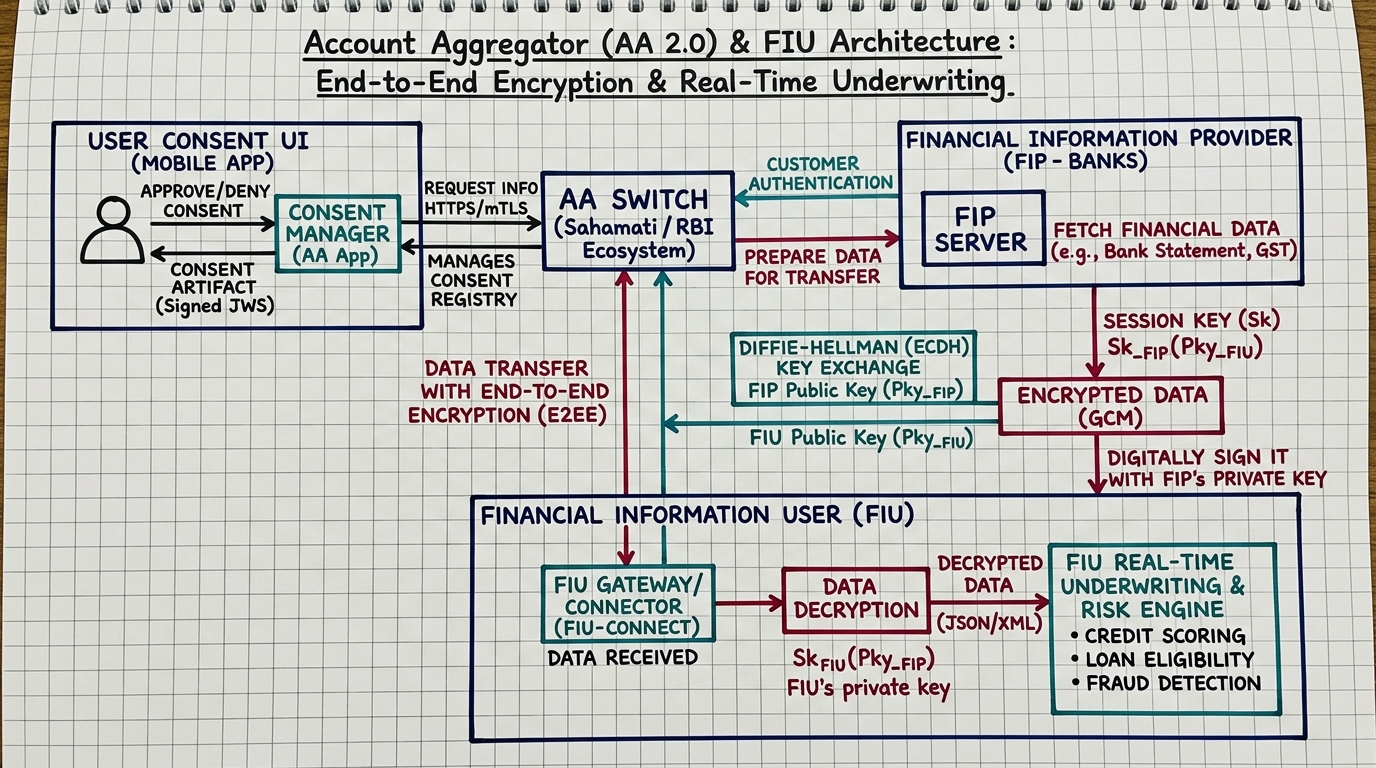
As illustrated in the hand-drawn technical whiteboard blueprint above, an AA data exchange operates across four discrete entities:
- Data Principal (Borrower): Grants explicit, granular consent on their registered AA mobile handle (e.g.,
user@onemoney,user@nadl,user@camspay). - Account Aggregator (AA Switch): An RBI-licensed NBFC-AA that acts as an oblivious data pipe. By regulatory mandate, the AA can neither view, decrypt, nor store customer financial payload data.
- Financial Information Provider (FIP): Scheduled Commercial Banks, Mutual Funds, Depository Participants (CDSL/NSDL), and GSTN holding customer assets and transactions.
- Financial Information User (FIU): The lending fintech, neobank, or payment gateway consuming the verified data to underwrite working capital loans or calibrate instant credit lines.
3. Cryptographic Deep-Dive: ECDH Key Exchange
To guarantee complete data privacy, financial payloads are encrypted end-to-end between the FIP and FIU using Curve25519 Elliptic Curve Diffie-Hellman (ECDH) combined with AES-GCM-256 authenticated encryption:
// FIU generates ephemeral keypair per session request
const fiuKeyPair = crypto.generateKeyPairSync('x25519');
const fiuPublicKeyBase64 = fiuKeyPair.publicKey.export({ type: 'spki', format: 'pem' });

// Consent Artefact JSON payload dispatched to AA Switch
const consentRequest = {
  ver: "2.0.0",
  timestamp: "2026-10-13T11:30:00.000Z",
  ConsentDetail: {
    consentMode: "VIEW",
    fetchType: "ONETIME",
    consentTypes: ["TRANSACTIONS", "PROFILE", "SUMMARY"],
    fiTypes: ["DEPOSIT", "TERM_DEPOSIT"],
    DataConsumer: { id: "FIU_PAISAPE_PROD" },
    Customer: { id: "9876543210@onemoney" },
    Purpose: { code: "101", refUri: "https://api.sahamati.org.in/purpose/101" },
    KeyMaterial: {
      cryptoAlg: "ECDH",
      curve: "Curve25519",
      params: "AES/GCM/NoPadding",
      Nonce: crypto.randomBytes(32).toString('base64'),
      DHPublicKey: { KeyValue: fiuPublicKeyBase64 }
    }
  }
};
4. Asynchronous Data Pipeline & Webhook Handlers
Because querying core banking systems (CBS) for up to 365 days of high-volume transaction statements can take 3 to 12 seconds per institution, AA 2.0 decouples consent generation from data fulfillment:
- Phase 1 (Consent Orchestration): The borrower approves the prompt via their mobile AA app or an embedded SDK. The AA issues a cryptographically signed XML/JSON Consent Artefact.
- Phase 2 (FI Data Request): The FIU sends the Consent Artefact along with its ephemeral public key and nonce to the AA, which fan-outs data requests to all linked FIPs.
- Phase 3 (Encrypted Payload Push): Each FIP encrypts statements using the FIU's public key and delivers the ciphertext via webhooks to the FIU's ingestion gateway.
- Phase 4 (Decryption & Ingestion): The FIU computes the shared secret, decrypts the JSON data in memory within an isolated execution boundary, and feeds the normalized ledger to its credit scoring model.
5. Core Metrics Table: AA 1.0 vs. AA 2.0 Rails
| Architecture Dimension | AA 1.0 Legacy | AA 2.0 Modern Standards |
|---|---|---|
| Consent Latency | 45 – 90 seconds (Redirect) | < 15 seconds (Headless Embedded SDK) |
| Cryptographic Standard | RSA-2048 / PKCS#1 v1.5 | Curve25519 ECDH + AES-256-GCM |
| Multi-FIP Support | Sequential polling per bank | Parallel async fanout via AA Switch |
| Recurring Monitoring | Manual re-consent per pull | Granular periodic auto-fetch triggers |
6. Fraud Mitigation & DPDPA Alignment
In adherence to India's Digital Personal Data Protection Act (DPDPA 2023) and RBI guidelines, the FIU must strictly enforce data minimization:
- Purpose-Bound Data Retention: Transaction statements must be purged automatically from raw storage once the credit scoring model produces its underwriting vector.
- Consent Revocation Hooks: If the Data Principal revokes consent inside their AA app, the AA switch fires an immediate revocation webhook to the FIU to terminate active monitoring jobs.
- Tamper-Proof Audit Logging: Every decryption session must be recorded in an immutable write-once read-many (WORM) audit table containing the Consent Artefact hash, timestamp, and invoking service identity.
Explore Related Fintech Engineering Guides
1. अकाउंट एग्रीगेटर (AA 2.0) का विकास
भारत का अकाउंट एग्रीगेटर (AA) फ्रेमवर्क डिजिटल लेंडिंग में एक क्रांतिकारी बदलाव लेकर आया है। आरबीआई द्वारा विनियमित और रेबिट (ReBIT) व सहमति (Sahamati) द्वारा मानकीकृत यह इकोसिस्टम फाइनेंशियल इंफॉर्मेशन प्रोवाइडर्स (FIPs) और फाइनेंशियल इंफॉर्मेशन यूजर्स (FIUs) के बीच सुरक्षित डेटा का आदान-प्रदान करता है।
AA 2.0 के तहत मल्टी-FIP रिक्वेस्ट्स, रीयल-टाइम अंडरराइटिंग और एंड-टू-एंड डिफिए-हेलमैन एन्क्रिप्शन लागू किया गया है, जिससे 12 महीनों का बैंक स्टेटमेंट डेटा 15 सेकंड से भी कम समय में प्रोसेस हो जाता है।
2. सिस्टम टोपोलॉजी और मुख्य घटक
जैसा कि ऊपर दिए गए हैंड-ड्रॉन आर्किटेक्चर डायग्राम में दर्शाया गया है, यह सिस्टम चार मुख्य इकाइयों पर कार्य करता है:
- डेटा प्रिंसिपल (ग्राहक): अपने AA हैंडल (जैसे
user@onemoney) से सहमति देता है। - अकाउंट एग्रीगेटर (AA Switch): आरबीआई लाइसेंस प्राप्त संस्था जो डेटा को बिना देखे या स्टोर किए केवल पाइपलाइन का काम करती है।
- फाइनेंशियल इंफॉर्मेशन प्रोवाइडर (FIP): बैंक और डिपॉजिटरी जो ग्राहक का वित्तीय डेटा रखते हैं।
- फाइनेंशियल इंफॉर्मेशन यूजर (FIU): फिनटेक या लेंडर जो लोन मंजूरी के लिए डेटा का विश्लेषण करता है।
3. मजबूत एंड-टू-एंड एन्क्रिप्शन (ECDH)
ग्राहक की वित्तीय गोपनीयता सुनिश्चित करने के लिए डेटा FIP से FIU तक Curve25519 ECDH और AES-256-GCM से एन्क्रिप्ट रहता है। अकाउंट एग्रीगेटर स्वयं भी इस डेटा को डिक्रिप्ट नहीं कर सकता।
4. DPDPA और डेटा सुरक्षा अनुपालन
डिजिटल पर्सनल डेटा प्रोटेक्शन एक्ट (DPDPA) के अनुसार, क्रेडिट निर्णय पूरा होते ही रॉ डेटा को डिलीट कर दिया जाता है और ग्राहक द्वारा सहमति रद्द करने पर सभी सक्रिय मॉनिटरिंग प्रक्रियाएं तुरंत रोक दी जाती हैं।