
Real-Time Payment Fraud Prevention: Velocity Rules, Mule Account Detection & Sub-50ms Risk Engines
A technical architecture guide to building sub-50ms payment fraud prevention systems — leveraging Apache Kafka event streams, Redis in-memory velocity evaluation, XGBoost machine learning risk models, and automated mule account freeze hooks.
1. The High-Speed Threat of Payment Fraud
In high-throughput instant payment networks (such as UPI, IMPS, and card switches), fraudulent transactions occur in milliseconds. Sophisticated fraud syndicates use compromised VPAs, velocity attacks, device cloning, and illicit "mule accounts" to siphon money before traditional batch fraud monitoring tools can flag the activity.
For modern payment gateways and banks, fraud prevention cannot be an offline post-facto audit process. It must evaluate every transaction in-flight with an end-to-end latency budget of < 50 milliseconds without deteriorating payment approval times or legitimate transaction success rates.
2. Architecture of a Sub-50ms Risk Engine
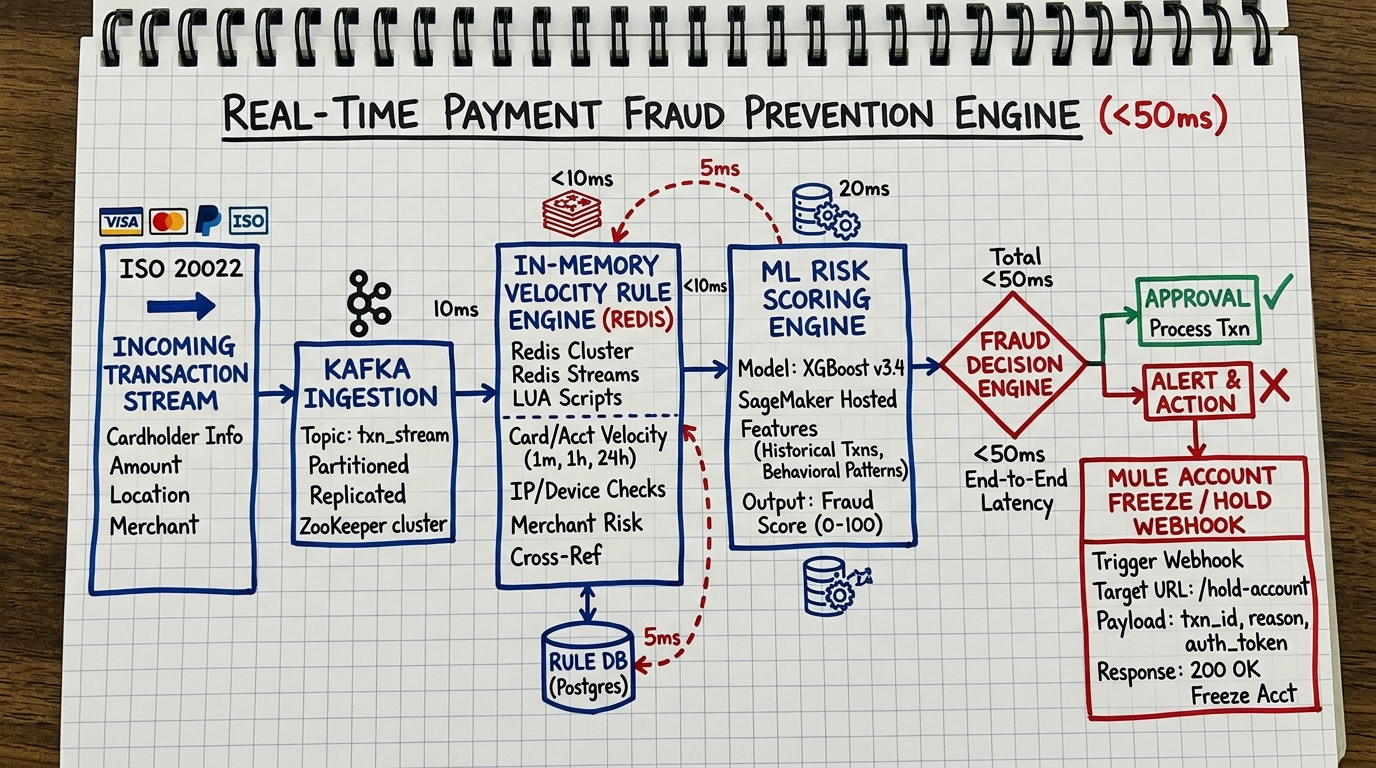
As detailed in the hand-drawn technical whiteboard blueprint above, the real-time fraud pipeline processes incoming payment payloads through five low-latency stages:
- ISO 20022 / UPI Payload Stream Ingestion (10ms): High-throughput Kafka topics ingest incoming transaction streams partitioned by VPA and card token.
- In-Memory Velocity Rule Engine (<10ms): Redis Cluster running custom Lua scripts evaluates card/account velocity across 1-minute, 1-hour, and 24-hour rolling windows.
- ML Risk Scoring Engine (20ms): Containerized XGBoost model (hosted on low-latency inference endpoints) calculates a dynamic Fraud Risk Score (0 to 100).
- Fraud Decision Engine (<5ms): Evaluates rule scores against risk thresholds:
- Score < 30: Approved instantly.
- Score 30 – 70: Triggers Step-Up 2FA / OTP challenge.
- Score > 70: Immediate Block & Mule Trigger.
- Mule Account Freeze Hook (Instant Webhook): Dispatches HTTP POST webhooks to compliance endpoints to freeze funds and lock compromised accounts.
3. Velocity Metrics & Mule Detection Signals
| Risk Vector | Detection Signal | Automated Action |
|---|---|---|
| VPA Burst Velocity | > 5 transactions in 60 seconds from same IP/Device | Temporary IP/VPA Cool-off (15 min) |
| Mule Account Rapid Drain | Account receives ₹1,00,000+ and immediately transfers 99% within 2 min | Instant Account Hold & Regulatory Alert |
| Geolocation Anomaly | Physical distance > 500 km between consecutive transactions in 5 min | Trigger Step-Up Biometric / 2FA |
4. Redis Lua Velocity Check Script
-- Redis Lua Script for 60-Second Rolling Window Velocity Check
local key = KEYS[1]
local limit = tonumber(ARGV[1])
local current_time = tonumber(ARGV[2])
local window = 60

redis.call('ZREMRANGEBYSCORE', key, '-inf', current_time - window)
local current_count = redis.call('ZCARD', key)

if current_count >= limit then
    return 1 -- Velocity Exceeded (Flag Fraud)
else
    redis.call('ZADD', key, current_time, current_time)
    redis.call('EXPIRE', key, window)
    return 0 -- Approved
end
1. डिजिटल फ्रॉड की गति और सुरक्षा चुनौती
UPI और त्वरित भुगतान नेटवर्क में जालसाज कुछ ही सेकंड में धोखाधड़ी के लेन-देन को अंजाम देते हैं। पारंपरिक ऑडिट प्रणाली के बजाय फिनटेक प्लेटफॉर्म्स को **< 50ms (मिलीसेकंड)** की समय सीमा में रियल-टाइम फ्रॉड रोकथाम लागू करना अनिवार्य है।
2. 50ms से कम समय में फ्रॉड डिटेक्शन आर्किटेक्चर
उपरोक्त हस्तनिर्मित वाइटबोर्ड आर्किटेक्चर आरेख के अनुसार, फ्रॉड इंजन 5 चरणों में काम करता है: 1) Kafka द्वारा डेटा इनजेशन (10ms), 2) Redis Velocity नियम जांच (<10ms), 3) XGBoost ML मॉडल द्वारा रिस्क स्कोरिंग (20ms), 4) निर्णय इंजन (<5ms), और 5) म्युल अकाउंट ब्लॉक वेबहुक।
3. Redis Velocity और Mule Account रोकथाम
यदि कोई खाता अचानक ₹1,00,000+ प्राप्त करके 2 मिनट के भीतर 99% राशि किसी अन्य खाते में स्थानांतरित करता है, तो सिस्टम स्वचालित रूप से म्युल अकाउंट अलर्ट जारी करके लेन-देन को होल्ड पर रख देता है।