
RuPay Credit Card on UPI: Issuer Switch Rails, Interchange Fee Mechanics & ISO 8583 Authorization
A deep technical breakdown of RuPay Credit Cards linked to UPI — translating XML/JSON payment payloads into ISO 8583 credit issuer switch messages, interchange revenue distribution, and merchant Acquiring MDR rules.
1. The Convergence of UPI and Credit Card Rails
Until recently, UPI transactions in India were strictly linked to savings/current bank accounts or prepaid wallets (P2P and P2M). With NPCI's rollout of RuPay Credit Cards on UPI, users can link their RuPay credit card to any UPI app (e.g. BHIM, PhonePe, Paytm, Google Pay) and execute 1-tap QR payments at millions of merchant outlets.
From a switch engineering perspective, this requires bridging two fundamentally different protocols: NPCI's XML/JSON API UPI switch network and the traditional credit card Card Management System (CMS) operating over ISO 8583 / ISO 20022 messaging standards.
2. Transaction Request Flow & Protocol Translation
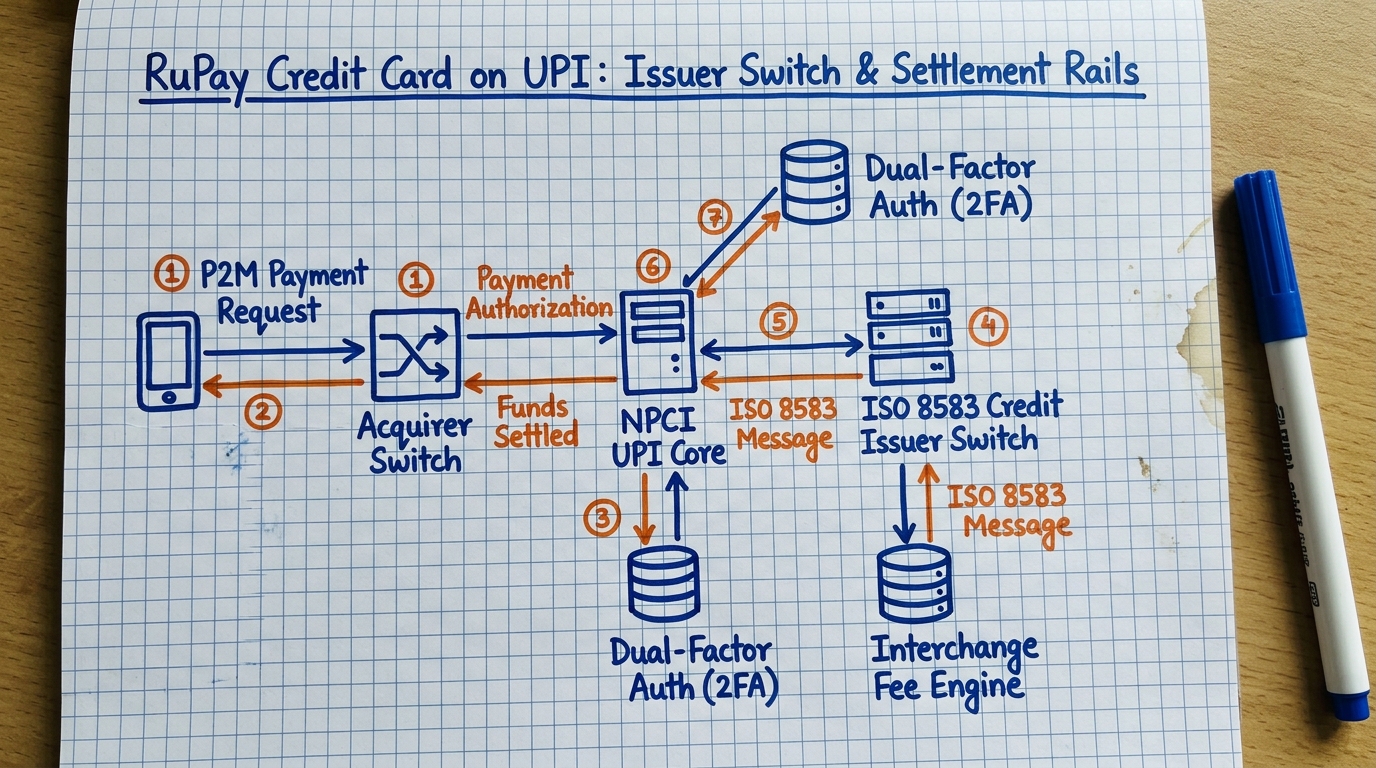
As visualized in the hand-drawn technical architectural whiteboard blueprint above, when a user scans a merchant QR code using a RuPay credit card on UPI:
- P2M QR Scan & Request Initiation: Customer app sends a UPI
ReqPayXML packet containing VPA, merchant ID, amount, and selected credit card account handle. - Acquirer Switch Rerouting: The acquirer switch checks MCC (Merchant Category Code) and passes the authorization request to the NPCI UPI Core Switch.
- Protocol Translation Layer: NPCI Core converts the UPI XML packet into an ISO 8583 financial transaction message (MTI 0200).
- Credit Issuer Authorization: The issuing bank's Credit Card Management System checks credit limit, 2FA PIN validity, and fraud score, returning an MTI 0210 response.
- Instant Settlement Confirmation: NPCI Core converts MTI 0210 back to UPI XML response, instantly notifying the merchant POS system.
3. Interchange Fee & MDR Pricing Tiers
To incentivize merchant adoption while protecting small vendors, NPCI established strict MDR (Merchant Discount Rate) rules for RuPay credit card UPI payments:
| Transaction Value | Applicable MDR Rate | Interchange Revenue Split |
|---|---|---|
| Small Merchants (≤ ₹2,000) | 0% (Zero MDR) | No MDR charged to merchant |
| Standard P2M (> ₹2,000) | Up to 2.0% | 1.5% Issuer Bank / 0.35% Acquirer / 0.15% NPCI |
| P2P (Peer-to-Peer) | Prohibited | Credit cards cannot be used for P2P transfers |
4. ISO 8583 MTI 0200 Payload Sample
0200 7220000000000000 165234567890123456 000000 000000050000 0926155200 102938 5411 001
[Field 2: PAN / Token] = "5234567890123456"
[Field 4: Amount] = "000000050000" (₹500.00)
[Field 11: System Trace Audit Number (STAN)] = "102938"
[Field 18: Merchant Category Code (MCC)] = "5411" (Grocery Stores)
[Field 39: Response Code] = "00" (Approved)
1. UPI और क्रेडिट कार्ड नेटवर्क का एकीकरण
भारत में क्रेडिट कार्ड्स पर पारंपरिक POS टर्मिनल स्वाइप के बजाय, **RuPay Credit Cards on UPI** के जरिए ग्राहक किसी भी QR कोड को स्कैन करके क्रेडिट कार्ड से 1-टैप भुगतान कर सकते हैं।
तकनीकी दृष्टिकोण से, यह NPCI के UPI XML प्रोटोकॉल को क्रेडिट कार्ड के पारंपरिक **ISO 8583 संदेश मानकों** के साथ एकीकृत करता है।
2. लेन-देन और प्रोटोकॉल अनुवाद
जब कोई ग्राहक QR कोड स्कैन करता है, तो NPCI कोर स्विच XML पेलोड को MTI 0200 ISO 8583 संदेश में बदलता है और इश्यूइंग बैंक को भेजता है। स्वीकृति (MTI 0210) मिलने पर तुरंत मर्चेंट को भुगतान प्राप्त होता है।
3. MDR दरें और नियम
₹2,000 से कम के लेन-देन पर मर्चेंट को कोई शुल्क (Zero MDR) नहीं देना पड़ता है। ₹2,000 से अधिक के लेन-देन पर 2.0% तक MDR लागू होता है, जिसका बड़ा हिस्सा इश्यूइंग बैंक को प्राप्त होता है।