
SoftPOS & NFC Tap-to-Phone: Host Card Emulation (HCE) & EMV MPoC Compliance
An engineering guide to turning commercial Android devices into certified contactless POS terminals — implementing ISO/IEC 14443 NFC controllers, RuPay qSPARC and Visa L2 kernels, PCI MPoC security attestation, and sub-500ms payment switches.
1. The Merchant Acquiring Shift: From Dedicated POS to SoftPOS
Deploying traditional electronic data capture (EDC) terminals across millions of Indian micro-merchants incurs significant capital and operational expenses: device acquisition costs (₹8,000 – ₹14,000), SIM connectivity subscriptions, battery degradation, and thermal printer maintenance. SoftPOS (Software Point of Sale), also known as Tap-to-Phone or Tap-on-Phone, transforms an existing NFC-enabled Android smartphone into a fully certified contactless card terminal.
By leveraging Android's Host Card Emulation (HCE) architecture and complying with PCI's MPoC (Mobile Payments on COTS) standard, acquirers can onboard merchants instantly via software without shipping a single piece of hardware.
2. Technical Architecture & Transaction Flow
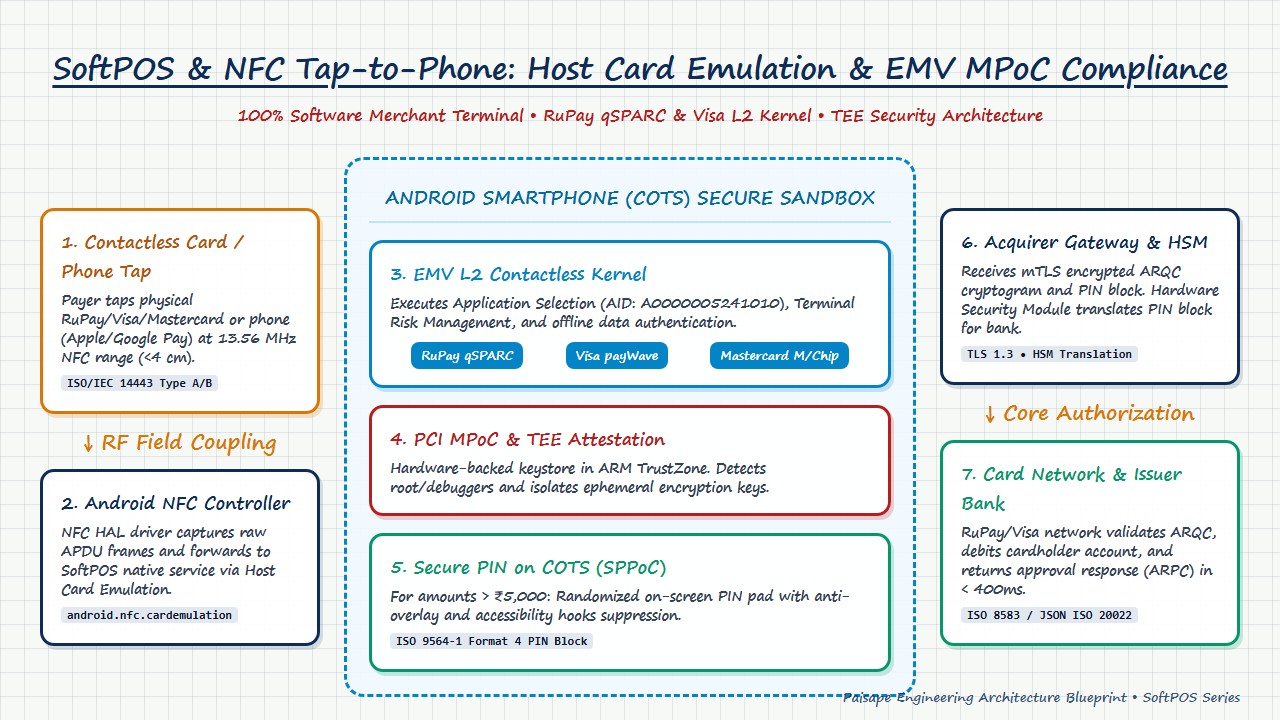
As illustrated in the hand-drawn technical whiteboard blueprint above, a SoftPOS transaction executes across five tightly coupled zones:
- Contactless EMV Interaction (ISO/IEC 14443 Type A/B): The payer taps their contactless card (RuPay, Visa, Mastercard) or tokenized smartphone (Google Pay, Apple Pay) on the merchant's NFC antenna at 13.56 MHz.
- EMV Level 2 Contactless Kernel Execution: An embedded C++/Rust native kernel executes the terminal risk management routine, application selection, and offline dynamic data authentication (fDDA/CDA).
- PCI MPoC Attestation & TEE Sandbox: The Android Trusted Execution Environment (TEE) verifies hardware integrity, confirms the OS is not rooted, and encrypts sensitive cardholder data in isolated memory.
- Software PIN Pad on COTS (SPPoC / MPoC PIN): For transactions exceeding ₹5,000 (India's contactless limit without PIN), the app renders an ephemeral, randomized on-screen PIN pad with anti-screen-scraping and anti-overlay defences.
- Hardware Security Module (HSM) Authorization: The encrypted PIN block (ISO 9564-1 Format 4) and card cryptogram (ARQC) are dispatched over TLS 1.3 to the acquirer switch and upstream card scheme networks.
3. APDU Command Exchange Sequence
The contactless kernel communicates with the card IC chip via standard ISO 7816-4 Application Protocol Data Units (APDUs). A typical transaction exchange requires less than 350 milliseconds:
// 1. SELECT Application (e.g. RuPay qSPARC AID: A0000005241010)
C-APDU: 00 A4 04 00 07 A0 00 00 05 24 10 10 00
R-APDU: 6F 28 84 ... (FCI Template containing PDOL) 90 00

// 2. GET PROCESSING OPTIONS (GPO with Terminal Transaction Qualifiers)
C-APDU: 80 A8 00 00 0B 83 09 38 00 00 00 00 00 01 00 00 00
R-APDU: 77 1E 82 02 19 80 94 18 ... (AIP and AFL lists) 90 00

// 3. READ RECORD (Retrieve Cardholder PAN & Track-2 equivalent)
C-APDU: 00 B2 01 0C 00
R-APDU: 70 34 57 13 45 32 XX XX XX XX 88 21 D2 81 22 01 ... 90 00

// 4. GENERATE AC (Request Online Authorization Cryptogram - ARQC)
C-APDU: 80 AE 80 00 29 ... (Terminal Verification Results & Amount)
R-APDU: 77 2B 9F 26 08 4E 8A 19 C0 ... (ARQC Cryptogram) 90 00
4. The PCI MPoC Standard: What Engineers Must Enforce
PCI's MPoC standard supersedes legacy CPoC and SPoC specifications by enabling both PIN entry and contactless transactions within a single unified certification. Crucial engineering requirements include:
- Continuous Attestation: The SoftPOS client must submit cryptographic device health tokens to an Attestation Server every 15 minutes. If a debugger is attached or Magisk root is detected, the cryptographic keys are wiped instantly.
- White-Box Cryptography: Encryption keys must never reside in plaintext within RAM. Acquirers employ white-box AES-256 engines that obfuscate mathematical transformations.
- Anti-Shoulder Surfing PIN Pad: Every PIN entry screen scrambles button positions randomly, rotates tactile touch offsets, and suppresses Android accessibility services.
5. Comparison: Dedicated EDC Machine vs. SoftPOS App
| Feature | Dedicated Hardware POS | COTS SoftPOS App |
|---|---|---|
| Hardware Capital Cost | ₹8,000 – ₹14,000 per device | ₹0 (Merchant's own phone) |
| Onboarding Lead Time | 3 – 7 days (courier shipment) | Instant (< 2 minutes via app download) |
| Supported Card Types | Dip, Swipe, Tap | NFC Contactless & Wearables |
| Firmware Updates | Manual TMS flash over GPRS | Seamless Google Play Store OTA update |
6. Sub-500ms Switch Optimization
To deliver an instant tap experience comparable to physical soundboxes, the payment gateway must optimize upstream communication:
- Persistent mTLS Keep-Alives: SoftPOS applications maintain persistent mutual-TLS 1.3 TCP connections with the payment gateway to eliminate handshake overhead during card tap.
- Zero-Copy ISO 8583 Parsers: Use binary protocol buffers or memory-efficient C-based ISO 8583 packers to route financial authorizations straight into the banking switch.
- Dual Audio-Visual Feedback: Confirm payments on the phone's screen and immediately emit the local transaction audio prompt in the merchant's chosen language.
Related Acquiring & Terminal Engineering
1. सॉफ्टपीओएस (SoftPOS): स्मार्टफोन बना स्वाइप मशीन
पारंपरिक पीओएस (POS/EDC) मशीनें खरीदना और उनका रख-रखाव करना छोटे व्यापारियों के लिए काफी खर्चीला होता है। सॉफ्टपीओएस (SoftPOS) तकनीक एक सामान्य एनएफसी (NFC) वाले एंड्रॉइड स्मार्टफोन को सीधे सुरक्षित कार्ड स्वाइप मशीन में बदल देती है।
पीसापे के आधुनिक सॉफ्टपीओएस आर्किटेक्चर से व्यापारी सिर्फ ऐप डाउनलोड करके कुछ ही मिनटों में रुपे (RuPay), वीजा और मास्टरकार्ड से संपर्क-रहित (Contactless Tap) भुगतान स्वीकार करना शुरू कर सकते हैं।
2. तकनीकी सुरक्षा और एमपॉक (PCI MPoC) मानक
जैसा कि ऊपर दिए गए आर्किटेक्चर आरेख में दिखाया गया है:
- NFC कार्ड टैप: ग्राहक अपना कार्ड या फोन मर्चेंट के मोबाइल के पीछे टच करता है।
- सिक्योर एलिमेंट एन्क्रिप्शन: फोन का TEE प्रोसेसर कार्ड विवरण को तुरंत एन्क्रिप्ट करता है।
- स्क्रीन पर पिन (PIN on COTS): ₹5,000 से अधिक के भुगतान के लिए स्क्रीन पर सुरक्षित रैंडम पिन पैड आता है।
- उप-सेकंड सेटलमेंट: सुरक्षित HSM स्विच के माध्यम से भुगतान 500 मिलीसेकंड में प्रोसेस होता है।
3. खुदरा व्यापार के लिए भारी बचत
हार्डवेयर मशीन की कोई लागत (₹0) नहीं, मेंटेनेंस की झंझट नहीं, और प्ले स्टोर से आसान अपडेट्स — यह भारत के लाखों छोटे व्यापारियों को डिजिटल भुगतान से जोड़ने का सबसे प्रभावी माध्यम है।