RBI Digital Payment Security Controls (DPSC 2026): Switch Throttling, Rate Limiting & Session Security
An engineering architecture guide to RBI's updated Digital Payment Security Controls (DPSC 2026) — implementing Redis rate-limiting (50/day balance check caps), device-bound session tokens (<10 mins TTL), anti-phishing domain isolation, and 7-year WORM audit logging.
1. The Need for DPSC 2026 Mandates
With Indian payment switches processing over 500 million daily transactions, payment infrastructure faces sophisticated cyber threats — including automated balance check scraping, session hijacking, credential stuffing, and SIM-swap fraud. In response, the Reserve Bank of India (RBI) issued updated **Digital Payment Security Controls (DPSC 2026)** to enforce strict application-layer security across all banks, Small Finance Banks, and licensed Payment Aggregators.
2. Architecture of a DPSC-Compliant Switch Pipeline
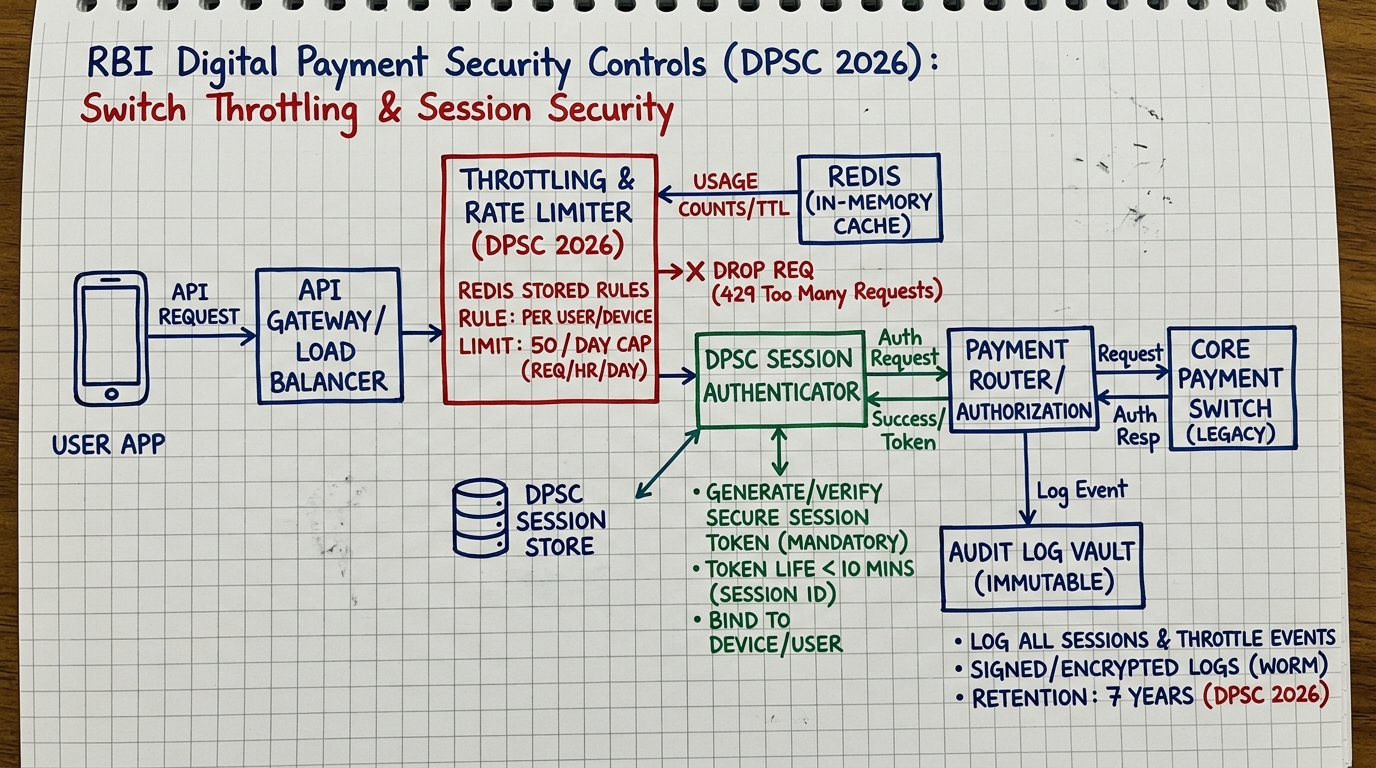
As visualized in the hand-drawn technical architectural whiteboard blueprint above, a DPSC 2026 compliant payment switch enforces security across five distinct layers:
- API Gateway & Load Balancer: Ingests encrypted HTTPS requests with mandatory TLS 1.3 protocol validation.
- Throttling & Rate Limiter (Redis Engine): Enforces strict per-user/device daily limits — including NPCI's 50 balance checks per day cap — returning
429 Too Many Requestsupon breach. - DPSC Session Authenticator: Issues device-fingerprinted, cryptographically signed session tokens with a strict Time-to-Live (TTL < 10 minutes).
- Payment Router & Authorization: Reroutes valid payment payloads to legacy core banking switches.
- Immutable Audit Log Vault (WORM): Writes signed event logs to Write-Once-Read-Many (WORM) storage retained for 7 years as mandated by RBI.
3. Rate-Limiting Policy Matrix (DPSC 2026)
| API Endpoint | DPSC 2026 Limit Cap | Enforcement Strategy |
|---|---|---|
| UPI Balance Query | Max 50 / User / Day | Redis sliding window + Device ID binding |
| MPIN Verification Attempts | Max 3 Incorrect Attempts | 24-hour account lock + SMS notification |
| Session Idle Timeout | 5 Minutes | Automatic token invalidation & re-auth |
4. Redis Rate-Limiting Lua Script
-- DPSC 2026 Sliding Window Rate Limiter
local key = KEYS[1]
local limit = tonumber(ARGV[1]) -- 50
local current_time = tonumber(ARGV[2])
local window = 86400 -- 24 Hours in seconds

redis.call('ZREMRANGEBYSCORE', key, '-inf', current_time - window)
local req_count = redis.call('ZCARD', key)

if req_count >= limit then
    return 0 -- Rejected (DPSC Limit Exceeded)
else
    redis.call('ZADD', key, current_time, current_time)
    redis.call('EXPIRE', key, window)
    return 1 -- Allowed
end
1. DPSC 2026 सुरक्षा नियमों की आवश्यकता
भारतीय रिज़र्व बैंक (RBI) ने **Digital Payment Security Controls (DPSC 2026)** के तहत सभी बैंकों और पेमेंट एग्रीगेटर्स के लिए सख्त सुरक्षा नियम अनिवार्य किए हैं।
2. DPSC 2026 स्विच आर्किटेक्चर
यह आर्किटेक्चर प्रति दिन अधिकतम 50 UPI बैलेंस चेक की सीमा, 10 मिनट से कम सत्र टोकन वैधता, और 7 वर्षों के लिए सुरक्षित WORM ऑडिट लॉगिंग लागू करता है।