
RBI MuleHunter AI & Digital Intelligence Unit: Real-Time Mule Account Freezing & CFCFRMS 1930 Integration
An engineering analysis of the Reserve Bank of India's MuleHunter AI platform and Digital Intelligence Unit (DIU) rails — combining Graph Neural Networks (GNNs), citizen cyber fraud reporting APIs, automated debit freezes across downstream mule networks, and real-time fund clawback architectures.
1. The Rise of Multi-Layered Mule Account Networks
In high-speed instant payment environments like UPI and IMPS, fraudulent funds do not sit inside a single destination bank account. Cyber syndicates deploy automated scripts to layer stolen money through 5 to 15 intermediate accounts ("money mules") across different banks within 90 seconds, ultimately cashing out at ATMs or converting into cryptocurrency.
To combat this, the Reserve Bank of India (RBI) and the Indian Cyber Crime Coordination Centre (I4C) introduced MuleHunter AI, operated in conjunction with the Digital Intelligence Unit (DIU) and the national CFCFRMS (Citizen Financial Cyber Fraud Reporting and Management System / 1930 helpline) network.
2. System Topology: Detection to Inter-Bank Quarantine
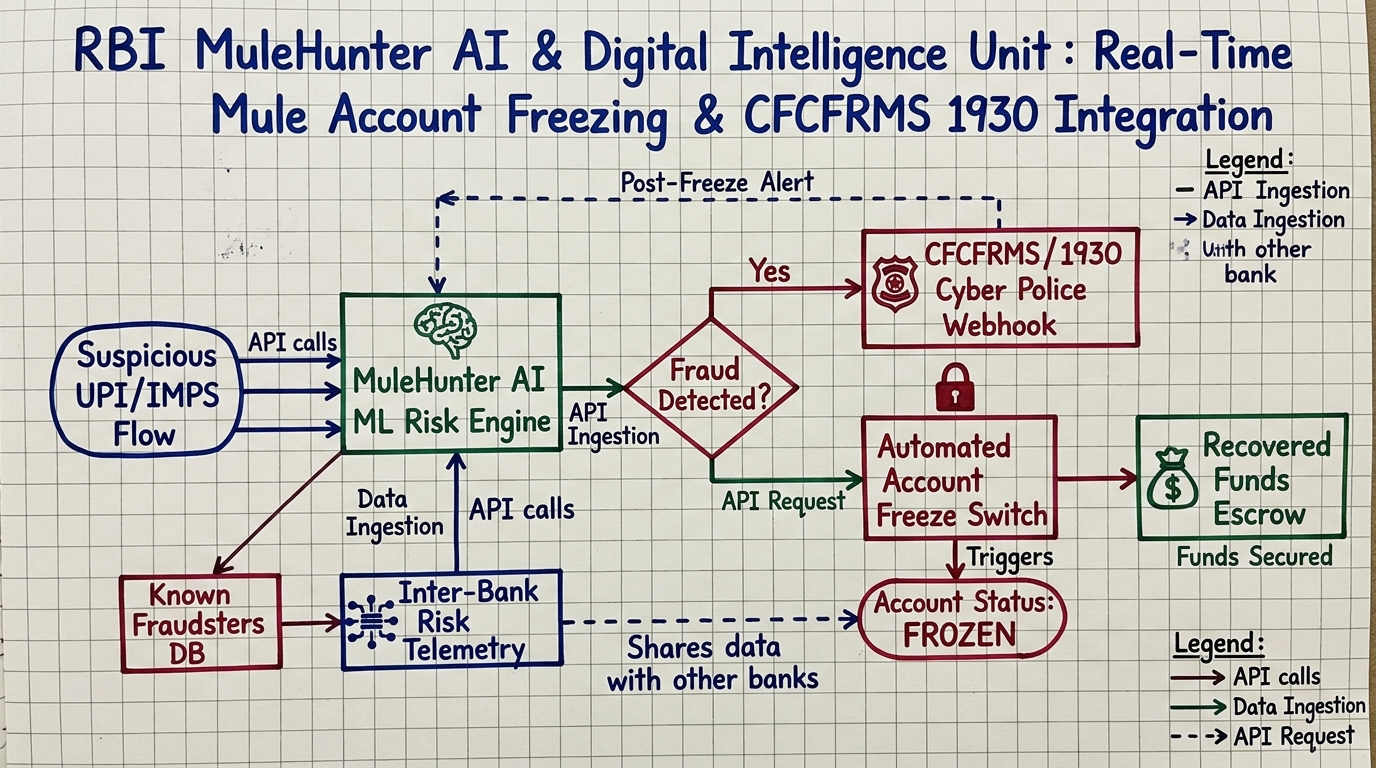
As visualized in our hand-drawn technical whiteboard blueprint above, the MuleHunter AI ecosystem operates across six synchronized nodes:
- Victim Incident Ingestion (1930 / CFCFRMS Webhook): When a victim logs a financial fraud complaint via the 1930 cyber helpline, an incident webhook containing the victim's UTR, debit timestamp, and initial recipient VPA/account is broadcast.
- MuleHunter AI Graph Analysis: A centralized Graph Neural Network (GNN) maps transactional velocity, device telemetry (IMEI/IP hopping), dormancy break ratios, and fan-out topology in real-time.
- Digital Intelligence Unit (DIU) Risk Broadcast: The DIU fires cryptographically signed
ACCOUNT_FREEZE_NOTICEpayloads to all downstream participant banks. - Automated Bank Switch Freezes: Core Banking Systems (CBS) instantly place lien holds or complete debit freezes on identified mule accounts in sub-100ms.
- Inter-Bank Clawback & Escrow: Traced funds are moved from quarantined mule nodes into a central escrow account for fast-track judicial restitution to the victim.
3. Technical Schema: CFCFRMS API Freeze Request
Banks and payment aggregators integrate directly with the I4C / DIU switch via secure mutual-TLS API endpoints. Below is a sample payload dispatched to freeze an active mule node:
{
  "diu_alert_id": "DIU_2026_MULE_9982104",
  "timestamp": "2026-10-21T11:30:00.000Z",
  "cfcfrms_ref": "1930_INC_88301142",
  "target_bank": {
    "iin": "508505",
    "ifsc_prefix": "HDFC",
    "account_number": "50100482910482",
    "vpa": "mule.transfers88@okhdfcbank"
  },
  "action_required": "IMMEDIATE_DEBIT_FREEZE",
  "freeze_amount": 145000.00,
  "risk_indicators": {
    "fanout_velocity_score": 0.96,
    "dormancy_break_ratio": "5000x_surge",
    "geo_anomaly": "Simultaneous_ATM_login_different_states"
  },
  "digital_signature": "MEQCIF98e2...signed_by_rbi_diu_hsm"
}
4. Key Behavioral Patterns Detected by MuleHunter AI
- Sudden Dormancy Break: Accounts with negligible balances for 6+ months that suddenly receive ₹2,00,000+ via UPI and immediately initiate rapid multi-split transfers.
- Zero-Balance Drain Cycles: Inflow funds being swept out within < 45 seconds to newly created beneficiary accounts or debit card ATM withdrawal attempts.
- Device Fingerprint Clustering: Single physical smartphones or rooted Android emulators managing 20+ banking apps with rotating virtual phone numbers.
5. Comparison: Manual Police Freezes vs. Automated MuleHunter AI
| Parameter | Traditional Police Notice (Sec 91 CrPC) | RBI MuleHunter AI & DIU Switch |
|---|---|---|
| Freeze Initiation Time | 24 – 72 hours (Email/Physical Notice) | < 100 milliseconds (API Webhook) |
| Downstream Layering Trace | Sequential bank-by-bank requests | Full GNN graph traversal across all banks |
| Fund Recovery Rate | < 8% (Money already cashed out) | > 65% (Funds blocked in transit) |
6. Engineering Best Practices for Payment Aggregators
To maintain high compliance and avoid regulatory penalties, payment switches and aggregators must implement automated fraud quarantine pipelines:
- Zero-Delay Webhook Ingestion: Ingest DIU freeze notifications through high-concurrency message queues (Apache Kafka) with automatic retry dead-letter queues (DLQ).
- Real-Time Lien Enforcement: Enable core banking APIs that place immediate lien holds on specific suspected transaction amounts without disrupting unrelated legitimate merchant balances.
- Audit Compliance Logging: Maintain immutable 7-year WORM logs containing every freeze event, timestamp, and judicial clawback reference for RBI inspections.
1. म्यूल अकाउंट्स और साइबर अपराध की नई चुनौतियां
यूपीआई और आईएमपीएस जैसे तेज गति वाले भुगतान तंत्र में साइबर अपराधी ठगी की रकम को तुरंत 5 से 10 अलग-अलग खातों ("म्यूल अकाउंट्स") में ट्रांसफर करके एटीएम से निकाल लेते हैं।
इस संगठित वित्तीय धोखाधड़ी को रोकने के लिए भारतीय रिजर्व बैंक (RBI) और गृह मंत्रालय के I4C ने 'MuleHunter AI' और डिजिटल इंटेलिजेंस यूनिट (DIU) की स्थापना की है, जो 1930 साइबर हेल्पलाइन के साथ मिलकर काम करता है।
2. रीयल-टाइम म्यूल डिटेक्शन और फ्रीज प्रक्रिया
जैसा कि ऊपर दिए गए हैंड-ड्रॉन आर्किटेक्चर आरेख में दिखाया गया है:
- 1930 शिकायत पंजीकरण: पीड़ित द्वारा शिकायत दर्ज करते ही स्वचालित अलर्ट जनरेट होता है।
- AI ग्राफ एनालिसिस: म्यूलहंटर AI मिलीसेकंड्स में पूरे मनी ट्रेल का विश्लेषण करता है।
- ऑटोमैटिक बैंक फ्रीज: संदिग्ध बैंक खातों पर तुरंत डेबिट फ्रीज लगा दिया जाता है।
- फंड रिकवरी: पैसे को ब्लॉक करके पीड़ित को वापस दिलाने के लिए एस्क्रो में सुरक्षित किया जाता है।
3. फिनटेक और बैंकों के लिए लाभ
पारंपरिक 24-48 घंटे की पुलिस नोटिस प्रक्रिया के मुकाबले, यह एपीआई-आधारित सिस्टम 100 मिलीसेकंड में काम करता है, जिससे 65% से अधिक ठगी की रकम को सुरक्षित बचा लिया जाता है।