
UIDAI Face Authentication (FaceRD) & Passive 3D AI Liveness Detection in Digital Onboarding
An engineering guide to UIDAI's FaceRD biometric SDK — incorporating passive 3D liveness detection AI, preventing presentation attacks (printed masks/screen replays), signed auth token verification, and Aadhaar Act compliance.
1. The Shift to Contactless Biometric Authentication
Traditional Aadhaar biometric eKYC relied on physical fingerprint scanners (STQC-certified OTG devices). This created hardware dependency and logistics friction for field onboarding and mobile-first fintech apps. With UIDAI Face Authentication (Aadhaar FaceRD), any smartphone camera can capture ISO-compliant facial biometrics for instant identity verification.
However, camera-only capture introduces serious security risks, such as presentation attacks (displaying a high-res photo, video replay, or 3D silicone mask). Preventing identity fraud requires coupling FaceRD with a Passive 3D Liveness Detection AI Engine that evaluates real human presence in under 200ms.
2. Architecture of the FaceRD & Liveness Pipeline
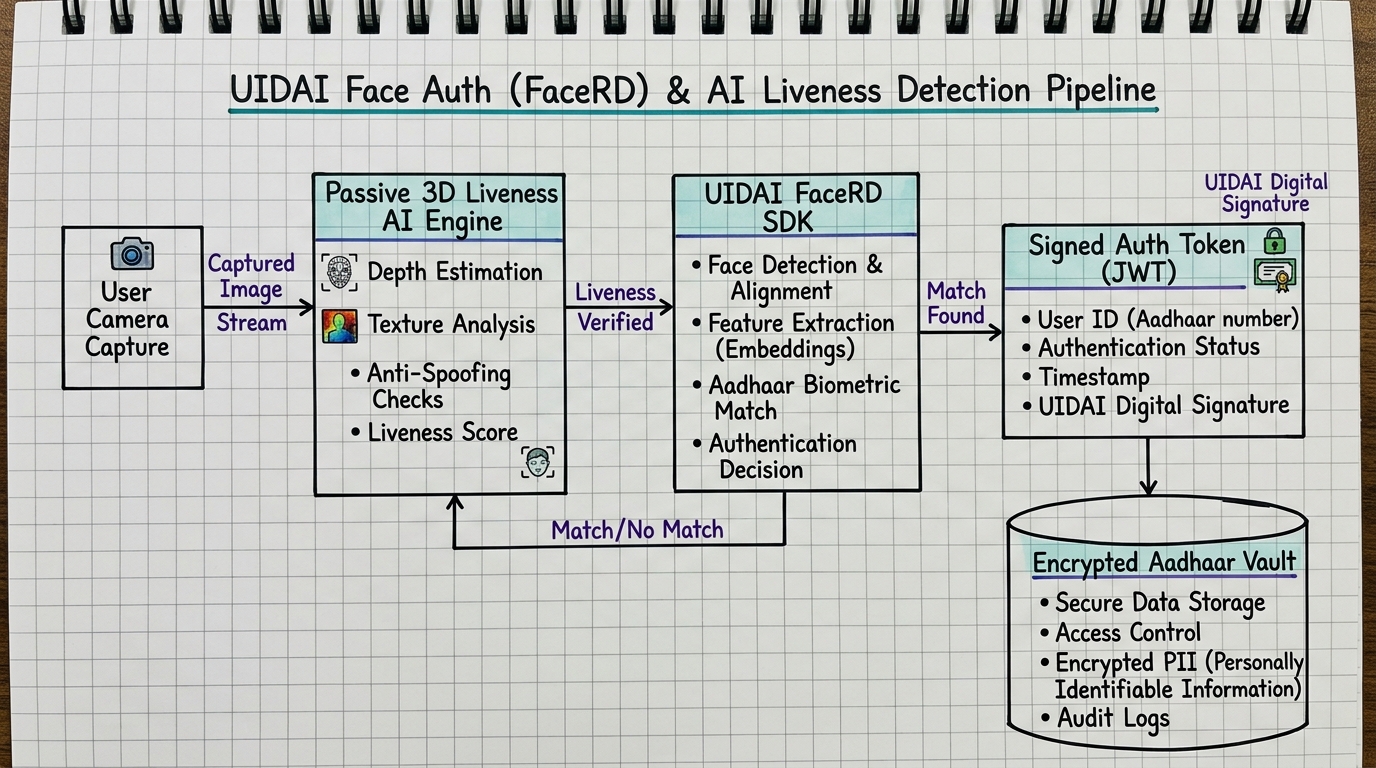
As illustrated in the hand-drawn technical architectural whiteboard blueprint above, the onboarding pipeline processes biometric verification through four sequential stages:
- User Camera Capture Stream: Captures high-frame-rate video frames (1080p, 30fps) with dynamic exposure compensation.
- Passive 3D Liveness AI Engine: Analyzes depth estimation (micro-reflections, parallax movement), skin texture, ocular micro-tremors, and anti-spoofing vectors without forcing the user to blink or turn their head.
- UIDAI FaceRD Native SDK: Packages the liveness-verified face frame into an encrypted PID block signed using the device's hardware-backed keystore.
- Signed Auth Token Verification: Calls UIDAI's Central Identities Data Repository (CIDR) via an AUA/KUA gateway, returning a signed JWT verification token.
3. Liveness Detection: Active vs. Passive AI Models
| Evaluation Factor | Active Liveness (Legacy) | Passive 3D Liveness AI (Modern) |
|---|---|---|
| User Action Required | Blink eyes, turn head, read out loud | None (Zero Effort / 1 Frame) |
| User Drop-Off Rate | High (15% – 22% failure rate) | Ultra Low (< 2%) |
| Spoof Prevention | Vulnerable to video loop replays | Blocks 3D masks, 4K screen replays, deepfakes |
| Execution Speed | 3.5 – 6.0 seconds | < 200 milliseconds |
4. FaceRD Auth Token Verification Payload
{
  "auth_status": "SUCCESS",
  "aadhaar_reference_id": "REF_998410294821",
  "liveness_score": 0.9942,
  "match_score": 98.6,
  "verification_timestamp": "2026-09-26T15:54:00Z",
  "uidai_signature": "MEYCIQC...=="
}
1. संपर्क रहित बायोमेट्रिक सत्यापन की ओर कदम
पारंपरिक आधार सत्यापन के लिए फिंगरप्रिंट स्कैनर डिवाइस की आवश्यकता होती थी। UIDAI Face Authentication (FaceRD) के साथ, ग्राहक अब अपने स्मार्टफोन कैमरे से तुरंत बायोमेट्रिक सत्यापन पूरा कर सकते हैं।
फर्जी तस्वीरों या स्क्रीन रिप्ले को रोकने के लिए, इस प्रक्रिया को **Passive 3D Liveness Detection AI Engine** के साथ जोड़ा जाता है जो 200ms से कम समय में वास्तविक मानव उपस्थिति का सत्यापन करता है।
2. FaceRD पाइपलाइन का आर्किटेक्चर
पाइपलाइन 4 चरणों में काम करती है: 1) कैमरा कैप्चर, 2) 3D पैसिव लाइवनेस AI जांच, 3) UIDAI FaceRD SDK द्वारा बायोमेट्रिक एनक्रिप्शन, और 4) UIDAI CIDR सर्वर से डिजिटल हस्ताक्षरित टोकन सत्यापन।
3. Passive बनाम Active Liveness
Passive Liveness तकनीक में यूजर को आंखें झपकाने या सिर घुमाने की जरूरत नहीं होती, जिससे 200ms के भीतर बिना किसी असुविधा के डीपफेक और 3D मास्क फ्रॉड को रोका जा सकता है।