
NPCI UPI Circle: Delegated Payments API Architecture, Permission Mechanics & Spent Limit Enforcement
An engineering guide to NPCI's UPI Circle framework — linking primary VPAs with secondary delegates, managing full vs. partial delegation modes, enforcing real-time velocity limits, and handling instant revocation hooks.
1. Evolution of Delegated Payments in UPI
Historically, digital transactions on India's Unified Payments Interface (UPI) required every payer to possess an active bank account linked directly to their mobile number and verified via MPIN. This created adoption friction for dependents (children, elderly family members) and corporate employees requiring petty cash allowances.
With NPCI UPI Circle, primary account holders can securely delegate payment authority to a secondary user (delegate) without sharing bank account access or MPIN credentials. The primary user maintains absolute governance, establishing strict monthly spending caps, single-transaction limits, and real-time instant revocation capabilities.
2. Architecture of NPCI UPI Circle
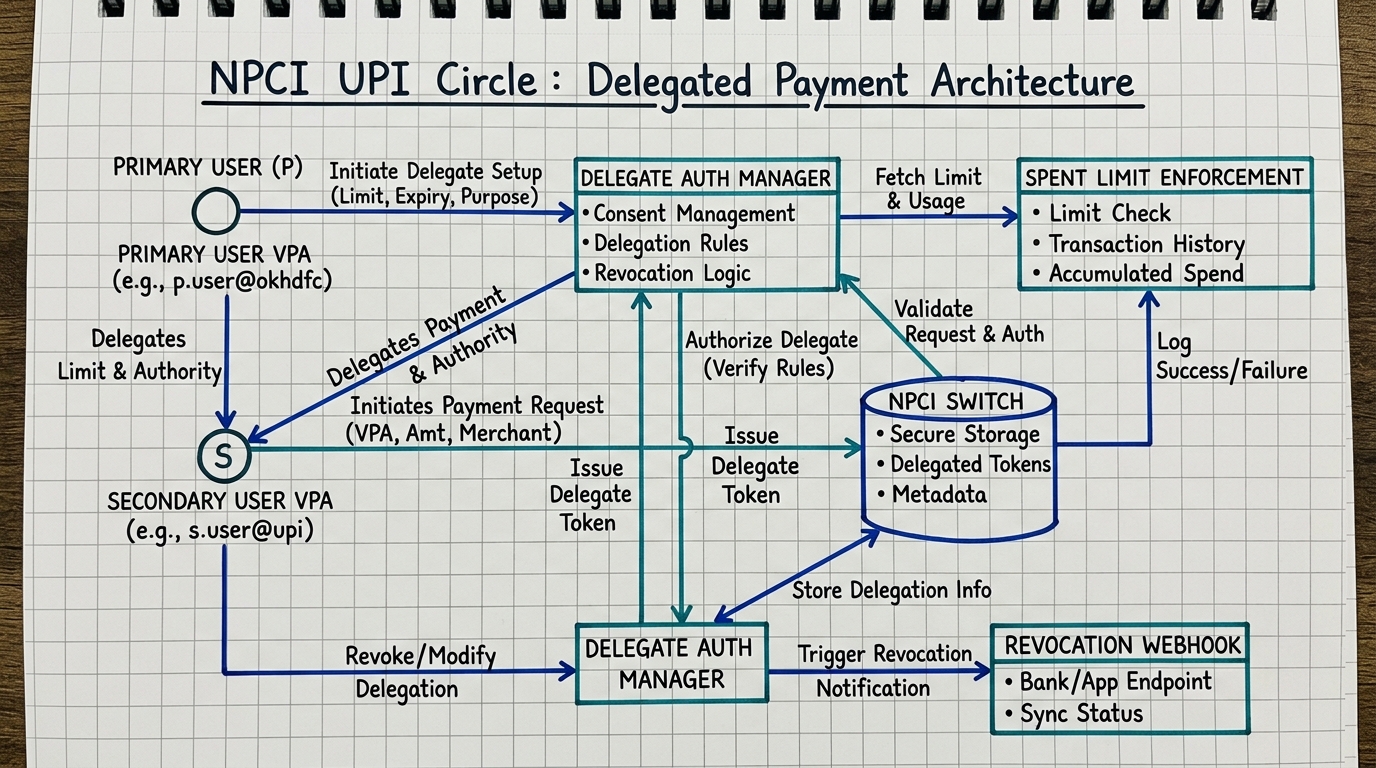
As illustrated in the hand-drawn technical whiteboard blueprint above, the UPI Circle framework consists of five core components:
- Primary User VPA & App: The account holder (e.g.
p.user@okhdfc) who authorizes delegation and sets monetary bounds. - Secondary User VPA & App: The delegate (e.g.
s.user@upi) who initiates merchant or peer payments drawn from the primary user's account. - Delegate Auth Manager Microservice: Manages consent tokens, delegation rules, valid time-to-live (TTL), and active authorization states.
- NPCI Core Switch & Token Vault: Encrypts delegated credentials into an append-only token registry that binds primary and secondary accounts.
- Spent Limit Enforcement Engine: Evaluates every transaction payload in real time against accumulated monthly spend and max per-txn caps.
3. Full Delegation vs. Partial Delegation Modes
| Delegation Parameter | Full Delegation (Auto-Approve) | Partial Delegation (Primary Approval) |
|---|---|---|
| Transaction Limit Cap | Max ₹15,000 / month (Per-txn cap ₹2,000) | Standard UPI limit (Up to ₹1,00,000) |
| Secondary User MPIN | Not Required (1-Tap Pay) | Not Required |
| Primary User Approval | Pre-authorized via token rules | Real-time push notification + MPIN authorization |
| Best Use Case | Daily micro-expenses (pocket money, groceries) | High-value purchases requiring parent/owner check |
4. Delegated Token Payload Schema
{
  "delegation_id": "DELG_88492049102",
  "primary_vpa": "p.user@okhdfc",
  "secondary_vpa": "s.user@upi",
  "mode": "FULL_DELEGATION",
  "limits": {
    "max_per_txn_inr": 2000.00,
    "monthly_cap_inr": 15000.00,
    "accumulated_spend_inr": 3450.00
  },
  "token_status": "ACTIVE",
  "expires_at": "2027-09-26T23:59:59Z"
}
5. Real-Time Revocation & Webhook Synchronization
If a primary user revokes secondary delegation from their mobile app, the Delegate Auth Manager instantly broadcasts an authenticated HTTP POST webhook payload to both NPCI Core and the PSP issuer switch:
POST /v1/upi/circle/revoke HTTP/1.1
Host: api.paisape.in
Content-Type: application/json
X-Signature: sha256=e3b0c44298fc1c149afbf4c8996fb92427ae41e4649b934ca495991b7852b855

{
  "event": "DELEGATION_REVOKED",
  "delegation_id": "DELG_88492049102",
  "timestamp": "2026-09-26T15:52:00Z"
}
1. UPI में डेलीगेटेड पेमेंट्स (Delegated Payments) का विकास
पारंपरिक रूप से, यूनिफाइड पेमेंट्स इंटरफेस (UPI) पर डिजिटल भुगतान करने के लिए प्रत्येक उपयोगकर्ता के पास अपना बैंक खाता होना अनिवार्य था। इससे परिवार के सदस्यों (बच्चों, बुजुर्गों) और कर्मचारियों के लिए दैनिक खर्चों में कठिनाई होती थी।
NPCI UPI Circle के माध्यम से प्राथमिक खाताधारक बैंक खाते की गोपनीय जानकारी साझा किए बिना किसी भी द्वितीयक उपयोगकर्ता (डेलीगेट) को सुरक्षित भुगतान अधिकार सौंप सकते हैं। प्राथमिक उपयोगकर्ता को मासिक सीमा और तुरंत अधिकार रद्द करने की पूरी स्वतंत्रता मिलती है।
2. UPI Circle का आर्किटेक्चर
उपरोक्त हस्तनिर्मित वाइटबोर्ड आर्किटेक्चर आरेख के अनुसार, UPI Circle में मुख्य रूप से 5 घटक शामिल हैं:
- Primary User VPA: मुख्य खाताधारक (जैसे
p.user@okhdfc) जो नियम और सीमा निर्धारित करता है। - Secondary User VPA: डेलीगेट (जैसे
s.user@upi) जो प्राथमिक खाते से भुगतान करता है। - Delegate Auth Manager: कंसेंट टोकन और नियमों की वैधता प्रबंधित करता है।
- NPCI Core Switch: टोकन रजिस्ट्री के माध्यम से प्राथमिक और द्वितीयक खातों को जोड़ता है।
- Spent Limit Engine: प्रत्येक लेन-देन पर रियल-टाइम खर्च सीमा की जांच करता है।
3. Full Delegation बनाम Partial Delegation
Full Delegation में प्रति माह ₹15,000 (प्रति लेन-देन ₹2,000) तक बिना MPIN के 1-टैप भुगतान की अनुमति होती है। वहीं Partial Delegation में उच्च मूल्य के लेन-देन के लिए प्राथमिक उपयोगकर्ता की रियल-टाइम स्वीकृति आवश्यक होती है।